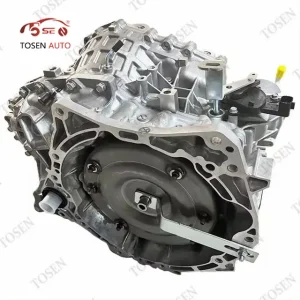
When you equip a fleet — delivery vans, utility pickups or passenger shuttles — the transmission choice shapes your fuel bill, your maintenance schedule and even your driver hiring pool. This guide compares manual and automatic gearboxes from the perspective of a fleet owner who has to live with the decision for years, not weeks.
Where Manual Transmissions Still Win
A manual gearbox remains the default for many commercial applications because of three hard numbers:
- Lower purchase price — typically 15–25% less than an equivalent automatic at the factory gate.
- Cheaper rebuilds — a manual gearbox is a set of gears, shafts, synchronizers and a clutch. Rebuilding one requires far fewer parts than rebuilding an automatic with its valve body, torque converter and clutch packs.
- Predictable fuel economy — in the hands of a trained driver, a manual can undercut an older automatic’s consumption by 5–8% in mixed driving.
Where Automatics Pay for Themselves
Urban stop-start routes change the maths. A modern automatic transmission shifts at the right point every time, which protects the driveline and cuts driver fatigue on 10-hour shifts. For vans that spend their lives in traffic, the automatic often returns better real-world economy than a manual — because the machine never picks the wrong gear.
Key Differences at a Glance
| Factor | Manual | Automatic |
|---|---|---|
| Initial cost | Lower | Higher |
| Rebuild cost | Lower | Higher |
| Urban fuel economy | Driver-dependent | Consistently good |
| Driver fatigue | Higher on long shifts | Lower |
| Resale demand | Regional | Higher in most markets |
| Transmission control unit | Not required | Required (TCU/ECU) |
What to Inspect When Buying a Replacement Gearbox
Whatever you choose, buying a replacement gearbox demands the same checks:
- Match the OEM part number (e.g. Toyota 33030-0W641 for Hiace 3L applications).
- Confirm the bellhousing pattern matches your engine code.
- For automatics, ask whether the TCU or valve body is included and tested — a gearbox without its control unit is only half a part.
- Request photos of the actual unit and its serial plate.
Fleet managers who standardize on one driveline configuration — one manual pattern or one automatic family — simplify parts stocking and driver training. If your routes are mixed, many operators keep manuals for highway freight and automatics for urban shuttles, and buy both from a single powertrain supplier to simplify procurement.