A DSG mechatronic wholesale supplier should make four things easy to verify: the exact part being offered, the software and test condition, the commercial terms, and the records that follow each unit. A low price or familiar gearbox-family name cannot replace those checks.
Start with one written requirement and send it unchanged to every candidate. Then compare supplier identity, assembly scope, sample evidence, MOQ, lead time, packing, delivery term, warranty and receiving support on the same basis.
Lock the Buying Requirement Before Contacting Suppliers
Write the requirement before collecting prices. A DQ200, DQ250 or DQ500 family label is only a routing clue. The supplier still needs the vehicle/application, gearbox code, complete old-unit number and suffix, photographs, required assembly, software condition, quantity and destination. If the order may cover several SKUs, create one line per requirement instead of combining unlike units under one description.
| Item | Description |
|---|
- Use uncropped old-unit photographs and record any earlier substitution.
- State new, remanufactured, repaired original or used condition explicitly.
- List required report files, labels, packing and warranty documents.
- Ask the supplier to mark every requirement confirmed, unavailable or not applicable.
Verify the Supplier and Responsible Site
Match the quotation, invoice, payment beneficiary, production or test site, warranty issuer and return address. A trading company can be a valid supplier, but the quote should say which organization performs sourcing, rebuilding, programming, testing, packing and claims. Ask who owns the method and retains unit records when more than one site is involved.
| Record | Useful check | Limit |
|---|---|---|
| Business registration and bank details | Do the contracting and payment identities agree? | Does not prove technical capability |
| Site address and process map | Where are units sourced, rebuilt, tested and packed? | Does not prove a specific unit completed the process |
| Quality certificate | Does the named entity/site have a stated management-system scope? | Does not replace the unit result or fitment check |
| Sample and unit record | What happened to the identified item? | Does not prove production capacity by itself |
| Customer references or shipment history | Has the supplier handled similar orders? | Must be relevant, permissioned and independently checked |
- Verify the legal entity and payment beneficiary before deposit.
- Confirm the responsible production/test site and escalation contact.
- Ask how methods, fixtures, adapters, software and acceptance limits are revised.
- Record the retention period for unit, batch and claim data.
ISO describes ISO 9001 as a quality-management-system standard. Use a certificate only within its named entity, site and scope; it is not a fitment approval or the test result for the unit being purchased.
Normalize the Part, Assembly and Software State
Put every offer into a comparison table before judging price. One supplier may quote a controller, another a valve body with TCU, and another a complete mechatronic. The same headline part number can hide a different suffix, condition, connector, transferred part or software preparation. Require the supplier to repeat the exact quoted identity rather than replying with a family name or stock photograph.
| Field | Supplier answer must state | Why it matters |
|---|---|---|
| OE identity | Complete number, suffix and accepted alternatives | A family match does not establish the exact replacement |
| Assembly | Controller, conductor plate, valve body or complete mechatronic; included and excluded parts | Changes cost, installation work and test boundary |
| Condition | New, remanufactured, repaired original or used; core requirement | Changes evidence, warranty and return handling |
| Software | Blank, loaded, cloned or other defined state; remaining work | Moves programming and commissioning work to the correct party |
| Application | VIN/gearbox/vehicle basis used for confirmation | Makes the fitment decision reviewable |
| Substitution | Written approval and new identity/report before shipment | Prevents an untracked unit change |
Do not accept a broad compatibility sentence
Require the exact quoted suffix and supplied assembly on the pro forma invoice.
Keep fitment confirmation separate from software readiness and bench-test status.
Require written approval before any substitution.
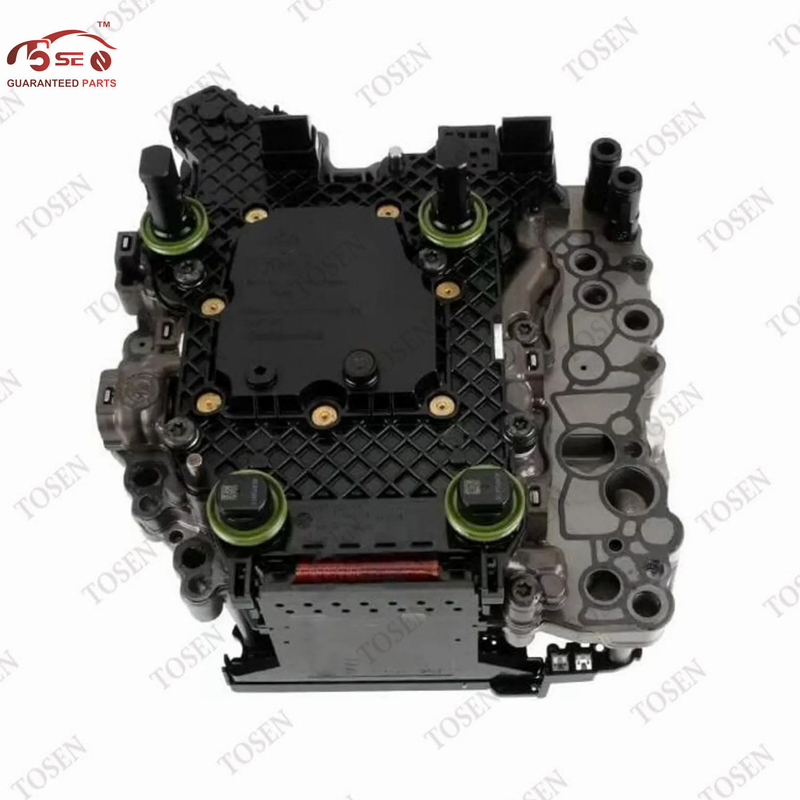
For a defined DQ500 requirement, the TOSEN 0BH927709A complete mechatronic page is a relevant enquiry route. Its product label starts the conversation; the VIN/application, installed label and supplier confirmation still control the order.
Validate a Sample With Unit-Linked Evidence
Treat the first unit as a controlled sample, not a shortcut to a large order. The label, supplier job number, report, packing and invoice should identify the same item. Ask what the bench or fixture stimulates, what readings or statuses are recorded, which limits apply, which functions are excluded, and whether the production order will use the same method and report format.
- Approve the sample identity — confirm OE number/suffix, assembly, condition, software state and required accessories before shipment.
- Review the supplier record — check method, fixture or harness, conditions, actual readings or statuses, limits, exceptions, retests and final disposition.
- Receive without losing evidence — photograph the carton, seal, labels and damage; open the original report file and match identifiers.
- Install and commission — keep the initial scan, programming/coding/basic-settings record and final result required by the exact application.
- Close the sample decision — record accepted gaps, corrections, production method, report set, packing and change-control rule.
A sample pass is not a production promise by itself
State whether production evidence is unit-level, batch-level or sample-based.
Require notice and approval for changed components, software, method, site or report format.
Keep the failed or replaced sample trail instead of retaining only the final page.
Compare MOQ, Lead Time and Landed Terms
| Quote field | Required detail | Risk if omitted |
|---|---|---|
| Sample and MOQ | Sample quantity, production MOQ, mixed-SKU rule and price breaks | A cheap line may require an unsuitable volume |
| Lead time | Trigger date, production time, test/report time and dispatch date | Deposit, approval and production dates become confused |
| Packing | Unit protection, connector caps, moisture control, labels, carton/pallet and included files | Damage or identity loss appears after handoff |
| Delivery term | Chosen Incoterms rule, version and exact named place/point | Cost and risk transfer remain ambiguous |
| Payment | Currency, deposit/balance trigger, beneficiary and bank charges | Cash exposure is hard to compare |
| Change control | Approval required for identity, component, site, method or software changes | Production can drift from the sample |
- Convert every offer to the same SKU, condition, software state, quantity and destination.
- Add report, programming preparation, special packing, bank, freight, insurance, duty and receiving costs that apply.
- Compare the cash timeline: deposit, sample approval, production release, balance, dispatch and arrival.
- Run a small-order and production-order scenario; do not hide sample cost inside the future unit price.
ICC advises naming the chosen Incoterms rule together with the port, place or precise point and the 2020 version. The rule does not define product fitment, quality, payment or warranty, so keep those terms in the quotation and contract.
Put Warranty and Claim Evidence in Writing
- Warranty start: invoice, shipment, delivery or installation date.
- Covered item: controller, valve body, complete mechatronic, software work, labor or freight.
- Exclusions: wrong application, unapproved programming, installation, contamination, external hydraulic/mechanical fault or transit damage.
- Claim file: unit labels, report, invoice, packing, receiving photos, initial scan, installation and commissioning records.
- Authorization: whether opening, repair, programming or return needs written approval.
- Remedy and timing: technical support, repair, replacement, credit, refund, freight and core handling.
| Observed problem | Preserve first | Written question |
|---|---|---|
| Label or suffix mismatch | Carton, unit and document photographs | Will the supplier correct the report, replace the unit or authorize the substitution? |
| Transit damage | Unopened carton, seal and carrier record | Who files the freight claim and may the unit be opened? |
| No communication or setup failure | Power/ground check, controller ID, full scan and exact procedure status | What remote checks are authorized before return? |
| Symptoms remain after commissioning | Before/after scan, setup record and mechanical/hydraulic findings | What evidence separates unit, installation and vehicle-side causes? |
Do not accept “warranty included” as the complete term. The useful warranty is the written path from an identified unit and preserved evidence to an authorized remedy.
Control Receiving and Installer Handoff
- Photograph the unopened shipment, labels, seals and any damage before units leave receiving.
- Match each OE number, suffix and serial/job reference to the purchase order, invoice, packing list and promised report.
- Quarantine mismatches, missing files, damaged connectors/housings or unapproved substitutions before installation.
- Give the installer the application, old-unit label, supplied scope, software state, report, setup boundary and warranty instructions together.
- Return the installation and commissioning result to the unit record; keep the original unit until acceptance or claim closure.
The evidence chain should survive handoffs
Quote identifies what was promised.
Physical label and report identify what arrived.
Workshop record identifies what was installed and completed.
Claim file preserves the first condition and authorized actions.
Browse the TOSEN transmission control unit range only after the family, OE suffix, assembly and software state are defined. If a buyer needs shared terminology first, use the TCU and mechatronics technical guide before issuing the RFQ.
Frequently Asked Questions
What should I send a DSG mechatronic supplier for a quote?
Send the VIN/application, gearbox code, full old-unit number and suffix, label photographs, required assembly, desired condition and software state, quantity, destination, required date, report fields and warranty expectations. Ask the supplier to repeat the exact quoted identity and exclusions.
Is the lowest MOQ automatically the safest first order?
No. A small sample can reduce exposure, but it is useful only if it matches the planned production scope, method, report, packing and software state. Record what must remain unchanged before the production release.
Does bench tested mean ready to install?
Not necessarily. Ask what was stimulated and recorded, which limits applied, and what programming, coding, authorized security work, basic settings or road learning remains. Bench scope, fitment and vehicle-side commissioning are separate questions.
Can an ISO 9001 certificate prove a mechatronic is good?
No. It can provide information about the named organization's quality-management system and certified scope. It does not identify your unit, prove fitment or replace the unit-specific test and receiving records.
Should a quote say EXW, FOB or DAP only?
No. State the selected Incoterms rule, the exact named port/place/point and the version, such as Incoterms 2020. Also write the product, quality, payment, packing, insurance, warranty and claim terms separately.
What should happen when the delivered suffix differs from the quote?
Do not install the unit. Photograph the carton, label and documents; quarantine the item; and ask for a written correction, approved substitution evidence or replacement. Preserve the original report and packing until the conflict is closed.
Send One Comparable DSG Mechatronic RFQ
Select a wholesale supplier only after the exact assembly, suffix, software state, sample evidence, production method, MOQ, delivery basis, warranty and receiving record are aligned. A consistent RFQ makes technical and commercial gaps visible before deposit.
Request a fitment and wholesale quote from TOSEN AUTO. Send the VIN/application, gearbox code, old-unit label and OE suffix, required assembly, software state, sample and production quantity, destination and report checklist. Ask for the exact quoted part, available evidence, lead time, packing and warranty terms in writing.