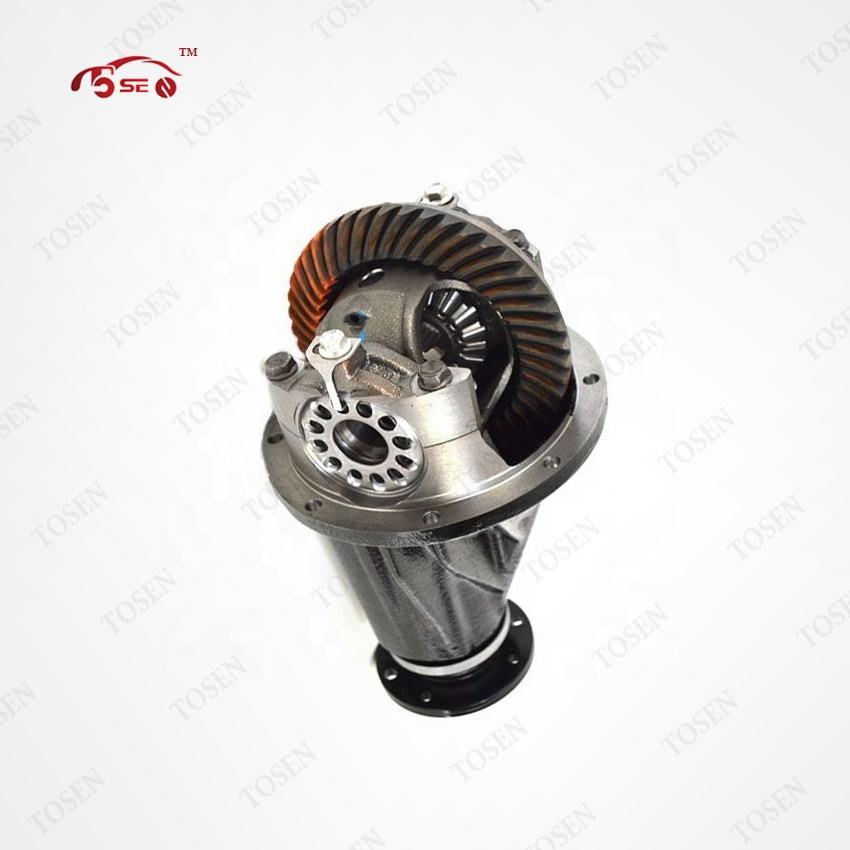
The two numbers on a Japanese truck axle tag, such as 9:41, are the pinion tooth count and the ring gear tooth count, and dividing the second by the first gives the final-drive ratio. That reading, taken from the axle itself rather than the model badge, is what a supplier needs before a replacement differential is built or shipped. Learning how to read the axle tag gear ratio takes minutes and prevents the most expensive mistake in this trade: a unit with the right badge but the wrong reduction.
This guide walks the full chain for Toyota Hiace, Isuzu NPR and Mitsubishi Fuso Canter axles: where the numbers physically sit, how to decode the stamp order, what to do when the tag is rusted or missing, and which checks beyond the ratio decide whether the unit actually installs. What the ratio number itself does to speed and torque is a separate question — our differential ratios explained guide covers that side of the decision.
Where the Ratio Information Lives on the Axle
Ratio information hides in four places on a light-truck axle, and you check them in the order that costs the least effort. On the vehicle, the first stop is the axle tag: a small metal plate bolted under one of the differential cover bolts. If the axle is already out on the bench, the stamps on the parts themselves are faster and harder to fake.
| Source | Where it sits | What it lists | When it fails |
|---|---|---|---|
| Axle tag (axle plate) | Metal plate under a differential cover bolt | Ratio in pinion:ring form, axle code, sometimes an OEM number | Rusts, gets painted over, or falls off with age |
| Housing stamp | Numbers punched into the differential housing casting | Ratio and axle code on many units | Grime and scale can hide the digits until cleaned |
| Ring gear stamp | Edge of the crown wheel, visible with the cover off | Tooth counts such as 41 and 9 | Needs the cover removed or the unit on the bench |
| Old-part label / OEM number | Tag or stamp on the removed unit | The exact OEM part number for cross-referencing | Only exists once the old unit is out and kept |
Photograph whichever source you find, including the whole tag and the bolts around it. A photo serves three later steps: decoding the numbers, cross-checking the axle code, and sending evidence with your quote request. If every source on the vehicle is unreadable, the fallback methods in the next section still get you the ratio.
How to Decode the Numbers on the Tag
On Japanese light-truck axles the tag and housing stamps read pinion first, ring gear second. A tag showing 9:41 means a nine-tooth pinion driving a forty-one-tooth crown wheel, and the ratio is the ring gear divided by the pinion: 41 divided by 9, or about 4.556:1. The order is the part that trips people up, because the rest of the world writes it differently — American-market axles carry the ratio as a decimal such as 3.73, and gear catalogues often write the ring gear first, as in 41/10. So 9:41 on a Hiace tag is not a part number and not 9.41 — it is nine pinion teeth against forty-one ring teeth, and the same information appears in three formats across tags, housing stamps and parts lists.
One ratio, three formats: the 9:41 worked example
Tag stamp 9:41 — pinion 9, ring 41
Ring gear mark 41/9 — the same pair written ring first
Decimal form 4.556:1 — that is 41 divided by 9
Sanity check with a sibling: a 10-tooth pinion against the same 41 ring gives 41 divided by 10, or 4.10:1 — one tooth changes the ratio, so close numbers are not interchangeable
| Model line | Stamp | Ratio (ring ÷ pinion) | Notes |
|---|---|---|---|
| Toyota Hiace | 9:41 | 41 ÷ 9 ≈ 4.556 | The common Hiace rear build |
| Toyota Hiace / Mitsubishi Pajero | 10:41 | 41 ÷ 10 = 4.10 | One pinion tooth apart — not interchangeable |
| Isuzu NPR class | 7:41 | 41 ÷ 7 ≈ 5.86 | Splits the NPR range with the 8:43 build |
| Isuzu NPR class | 8:43 | 43 ÷ 8 ≈ 5.38 | The other NPR rear build |
| Mitsubishi Fuso Canter PS100/PS120 | 6:40 | 40 ÷ 6 ≈ 6.67 | PS100 and PS120 take different units — the axle, not the badge, decides |
Run the division on your own reading and round to three decimals, then check the result against this table or the parts catalogue for your model. If your arithmetic lands between two known ratios, the stamp was probably misread — recount the teeth rather than guessing. And when the tag carries both a ratio and an axle code, keep both: the code locks the factory build, the market and the option in one string, which is why parts channels file axle components under those codes instead of model names. Isuzu NPR buyers can take the 7:41-versus-8:43 comparison further in our Isuzu NPR differential ratios guide.
When the Tag Is Missing: Ranked Fallbacks
| Rank | Method | Prerequisite | Precision | Also yields the axle code? |
|---|---|---|---|---|
| 1 | Ring gear stamp, cover off | Cover removed or unit on the bench | Exact tooth counts | No |
| 2 | Count the teeth on crown wheel and pinion | Old unit removed and opened | Exact | No |
| 3 | Axle code and chassis lookup in the parts catalogue | Chassis or VIN, and catalogue access | Exact for the factory build | Yes — this is the only channel that returns it |
| 4 | Driveshaft rotation count on the vehicle | One rear wheel jacked, helper or chalk marks | Approximate — good for separating clearly different ratios, not close ones | No |
Ranks one and two are physical proof, and they settle one specific question: the ratio. The axle code settles a different one: the factory build. When the two disagree — a code that points to a 9:41 build but teeth that count 10 and 41 — the truck has been re-geared at some point in its life, and both facts belong in your enquiry, because the ratio you order comes from the teeth while the carrier and spline build may still follow the code. Rank three works while the axle is still under the truck: Isuzu parts channels list axle components against axle codes and chassis numbers rather than model names, which is why a chassis number plus a legible axle code is the strongest vehicle-side pair you can send. Toyota and Mitsubishi buyers use the same route through their parts channels.
The rotation count is the quick field check, not the answer, and it assumes an open differential. Jack one rear wheel, leave the other on the ground, mark the tyre and the driveshaft, and turn the raised wheel exactly two full turns while counting driveshaft revolutions. On a limited-slip or locking rear the reading skews because the unit resists one-wheel rotation, so lift both wheels and turn them together, or skip the field check and rely on the stamped teeth. Either way, treat the count as a cross-check on a decoded number rather than a substitute for one, and if it disagrees strongly with the stamp, suspect a non-original gear set — and trust the teeth.
Why the Ratio Alone Does Not Prove Fitment
A correct ratio gets the unit spinning at the right speed; the interfaces decide whether it bolts in at all. Before ordering a complete assembly, compare the axle-shaft spline count, the input flange pattern and the housing connections against your own axle. A 9:41 assembly with the wrong splines is still a wrong part: the ratio number cannot carry the mechanical fit on its own.
On 4WD trucks the stakes double. The front and rear axles must turn at the same wheel speed for a given driveshaft speed, so both axle codes must agree. Fit a rear with a different ratio and the transfer case takes the difference as internal bind every time four-wheel drive engages on grippy ground: chain stretch, planetary wear and clutch-pack damage build over months and surface long after the install looked successful. The failure is invisible on delivery day, which is exactly why the code check belongs before the order, not after the noise.
Run the comparison in both directions before any money moves: check these items against your own axle, and deal with a supplier who cross-checks the carrier, splines and bearings against your axle code before anything is built.
- Front and rear axle codes agree (4WD trucks — both axles)
- Axle-shaft spline count matches your side shafts
- Input flange pattern and bolt circle match your driveshaft
- Housing and carrier match the mounting faces and bearing seats
- Complete assembly versus gear set decided — a gear set reuses your carrier, so its splines and bearing seats must be checked instead
- Differential type matches the truck's original build — open, limited-slip or locking units are not interchangeable
Turn the Reading Into a Safe Order
- Photograph the axle tag or the stamped numbers, including the bolts around it so the source is identifiable
- Record the pinion and ring gear tooth counts — read from the stamp, or counted with the cover off
- Write down the axle code and the chassis number or VIN the truck carries
- Note the axle-shaft spline count, the input flange pattern, and whether the truck carries an open, limited-slip or locking differential
- State the quantity and whether you need complete assemblies or gear sets, then send the whole pack in one message
Then ask what comes back. Before dispatch, a supplier doing this properly counts the teeth on the actual unit — confirming the nine-and-forty-one, not just the label — checks the gear mesh engagement, examines the splines and the input flange, and can send photographs of that physical assembly with its stamped markings together with the quotation. That exchange protects both sides: you can prove what you asked for, and the supplier can prove what shipped. When the pack is complete, request your quotation through the differential assemblies category or the product page for your axle, and keep the message thread with the photos as part of the order record.
What Each Failure Costs and Which Step Prevents It
| Failure mode | When it appears | Cost character | Prevented by |
|---|---|---|---|
| Wrong ratio on a 2WD truck | First drive — engine RPM, speedometer and shift points off | Return freight and downtime | Decoding the stamp and checking the arithmetic |
| Front/rear ratio mismatch on a 4WD | Months later — transfer-case bind, then noise and failure | Transfer-case rebuild, repeated teardown | Comparing both axle codes before ordering |
| Right ratio, wrong splines or flange | Installation day — the unit will not bolt in | Second unit plus two rounds of freight | The interface checklist in the fitment section |
| No evidence trail on the order | Whenever a dispute or a noise claim starts | Arguing with no record of what was asked or shipped | The evidence pack and supplier confirmation in writing |
Every row in that table traces back to a step that costs minutes. Reading the tag, running the division, comparing the codes and interfaces, and keeping the photo trail are cheap because they happen before money moves. The failures are expensive because they happen after it. That asymmetry is the whole argument for the procedure in this guide — and it is why the tag photo, not the model badge, should be the first thing in your next differential enquiry.
Frequently Asked Questions
Do front and rear axle tags show different numbers?
On a correctly matched 4WD truck they show the same ratio, usually written in the same stamp format. Different numbers on the two axles mean someone has already fitted a mismatched unit at some point, so trust neither badge and count the teeth on both ends before ordering anything.
The tag says one ratio but the teeth say another — which do I trust?
Trust the teeth. The tag describes what the factory fitted, but gears get swapped during a truck's life and the tag stays behind. Count the crown wheel and pinion teeth with the cover off and order against the physical counts, then tell the supplier about the mismatch so the record reflects the truck as built today.
Should I order a complete assembly or just the crown wheel and pinion set?
A complete assembly swaps in as one unit and suits workshops wanting minimum bench time. A gear set reuses your carrier, so it only makes sense when the carrier and bearings are sound and the tooth counts, splines and bearing seats all check out. The decision changes which interfaces you compare, not whether you compare them.
The tag is painted over — should I clean it or count teeth?
Clean it carefully first, because a legible tag also carries the axle code that the teeth cannot give you. Use a soft brush and solvent rather than abrasive, which destroys the stamping. If the digits stay unreadable, fall back to counting teeth on the removed unit and an axle code lookup through the chassis number.
My supplier will not confirm tooth counts before dispatch — what should I do?
Ask once, in writing, for photographs of the actual unit with its stamped tooth counts alongside the quotation. If the answer is still no, that order carries all of your risk with none of the evidence, and a supplier who inspects before shipping is the safer route for an international purchase.
Where is the axle code if the truck has no tag at all?
Check the chassis plate or build plate in the engine bay or door frame, and the chassis number stamped on the frame rail. Those feed the parts-catalogue lookup, which lists axle components against axle codes and chassis numbers rather than model names, and returns the axle code that the missing tag would have carried.
Use the Reading on Your Next Enquiry
The whole procedure compresses into one sentence: photograph what the axle actually says, decode the pinion-first stamp, verify with the teeth or the axle code, compare the interfaces and both 4WD codes, then send that evidence with your quote request and keep the confirmation on file. Readers sourcing now can take the completed pack straight to the differential assemblies category or the product page for their axle; anyone still diagnosing can simply hand the checklist to their supplier at the next enquiry.
Request your quotation through the differential assemblies page and attach the tag photo, tooth counts and axle code you gathered here.