The 7×41 and 8×43 gear-tooth combinations are the two Isuzu NPR final-drive specifications that TOSEN supplies as replacement differential assemblies, and each pairing produces a different reduction ratio inside the truck’s rear axle. Seven pinion teeth working against forty-one crown-wheel teeth calculate to approximately 5.857:1, while eight teeth against forty-three calculate to 5.375:1. The two figures sit less than half a ratio apart on paper, yet the assemblies behind them are not interchangeable: an NPR built to one specification cannot accept the other in its place. This guide compares the two ratios as they behave in service — what each number means in the driveline, why the NPR model name never identifies which ratio a specific truck carries, and which details an enquiry needs so the correct assembly ships the first time.
Two Tooth Counts, Two Final Drives
Both notations are tooth counts written in pinion-to-crown-wheel order, and the ratio each one produces comes from simple division: crown-wheel teeth divided by pinion teeth. The 7×41 combination gives 41 ÷ 7, a calculated final-drive ratio of approximately 5.857:1. The 8×43 combination gives 43 ÷ 8, a calculated ratio of 5.375:1. Expressed in shaft turns, a 7×41 NPR needs about 5.857 propeller-shaft revolutions for every revolution of the crown wheel and rear wheels, and an 8×43 truck needs 5.375 — a gap of roughly half a propeller-shaft turn per wheel revolution that runs through every metre the truck drives.
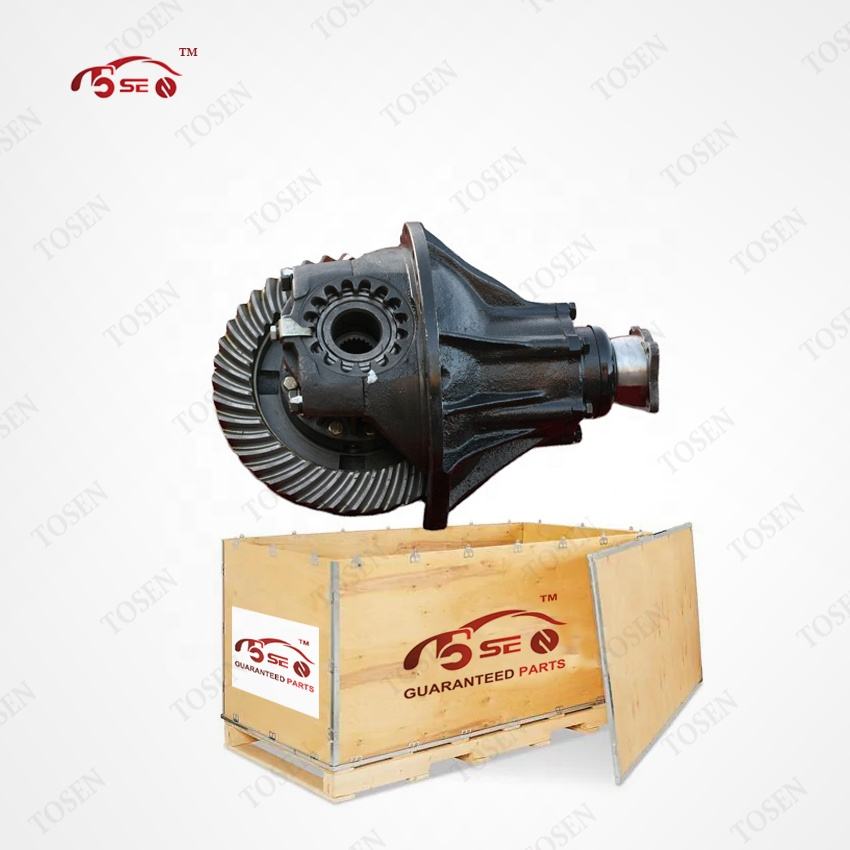
Both combinations serve the same physical role in the same vehicle family: each is the final-drive specification of an Isuzu NPR rear axle. TOSEN carries the two specifications across three listings. The 7/41 differential gear assembly for the Isuzu NPR and the 7×41 differential assembly both carry the seven-and-forty-one pairing, while the 8×43 rear differential assembly for the Isuzu NPR carries the eight-and-forty-three specification. The two 7×41 listings differ in supply scope — one is ordered as a gear assembly matched to the components a repair calls for, the other is supplied as a complete assembly that replaces the original final drive in a single exchange — so the ratio question and the scope question are settled separately at enquiry stage.
How Each Ratio Behaves in the Driveline
Mechanically, the two assemblies work through the same chain of components. The propeller shaft drives the pinion, the pinion turns the crown wheel, and the crown wheel both reduces the rotational speed and redirects the drive through a right angle into the axle housing. Side gears inside the carrier then divide the torque between the two rear axle shafts, which stay free to rotate at unequal speeds whenever the truck corners. What separates the 7×41 and 8×43 units is not this chain but the rate it works at: the number of propeller-shaft revolutions each specification demands per wheel revolution, and the torque multiplication it delivers in return.
That difference is why the two assemblies cannot be swapped. Installing a ratio the truck was not built with changes the relationship between engine speed and road speed: the speedometer and odometer report speeds and distances that no longer match the road, and the engine settles at a different point in its rev range for any given cruise speed. The truck’s pulling character shifts with it, because the torque multiplication at the axle is no longer the figure the driveline was designed around, and acceleration and load-handling behaviour move away from the intended delivery. A wrong-ratio assembly does not merely underperform — it quietly recalibrates the truck against its own instruments, which is why the tooth count is checked before an order is written, not after the unit is installed.
Why the NPR Model Name Never Settles the Ratio
Isuzu NPR trucks appear with more than one final-drive ratio, so the model designation on the bonnet answers nothing about the gearing inside the axle. The ratio a specific truck carries has to be read from the vehicle itself, and an NPR keeps that record in more than one place. The axle identification plate states the final-drive figures, the build documentation delivered with the truck repeats them, and the original gear set carries its own stamping. Where the paperwork is missing or the plate is unreadable, a direct count on the removed assembly settles the question: seven pinion teeth against forty-one crown-wheel teeth point to the 7×41 specification, and eight against forty-three point to 8×43.
The governing rule is simple and leaves no room for preference: the replacement assembly must match the specification the truck was built with. A faster-feeling or stronger-pulling alternative ratio cannot be introduced through the parts order, because the interfaces, the instruments and the driveline behaviour all assume the original figure. Fleets running mixed NPR units face the same discipline per vehicle — each truck is confirmed against its own records or its own gear count, and the order for that truck is written from that confirmation, not from what the truck next to it happens to carry.
Matching the Interfaces Beyond the Ratio
A correct tooth count is necessary but not sufficient, because an assembly with the right ratio still needs matching interfaces to install cleanly. The comparison between the removed unit and the ordered one covers the housing, the axle-shaft splines and the input flange, together with the mounting pattern or mounting arrangement and, for gear-level supply, the gear dimensions themselves. A unit that shares the ratio but differs in any of these interfaces turns a straightforward exchange into an adaptation job, so the interface details travel with the ratio through the whole ordering process.
The second question that runs alongside the interfaces is assembly scope — which components the supplied assembly actually includes. An axle that keeps its carrier needs a different supply than one being rebuilt from the housing out, so the enquiry states the scope together with the axle identification, and the delivered assembly is matched to that stated scope rather than to a fixed catalogue definition. Settling scope at enquiry stage keeps the workshop from having to bend the repair plan around whatever arrives in the crate.
Ordering from TOSEN: Verification and the Complete Enquiry
Every differential assembly TOSEN dispatches for the NPR is inspected before it ships, and the inspection is built around the two facts that define the part: the tooth count and the interfaces. The pinion and crown wheel are counted against the specification — seven against forty-one, or eight against forty-three — which gives the calculated ratio a physical verification, and the housing, splines, flange and mounting details are checked against the enquiry. Buyers running mixed fleets can request the counted record for each unit, which turns the ratio from an assumption carried through the order into a documented fact, and the verification accompanies the quotation on request.
An enquiry that gives the inspection something concrete to check against contains the same elements from the buyer’s side: the vehicle and axle identification, the ratio as read from the truck’s records or counted on the removed gears, the assembly scope the planned repair needs, the interface details of the original unit, and the quantity and destination. Photographs of the identification carried by the original assembly speed the verification, because the markings on the unit being replaced are the most direct evidence of what the truck carries. The 7×41 differential assembly listing and the 8×43 rear differential assembly listing on the TOSEN site carry the specification details for the two ratios compared in this guide, and the enquiry channel on each page reaches the quotation process directly.
Frequently Asked Questions
What is the difference between the 7×41 and 8×43 Isuzu NPR differential ratios?
The two notations describe different gear-tooth pairings inside the NPR rear axle: the 7×41 specification pairs a seven-tooth pinion with a forty-one-tooth crown wheel for a calculated final-drive ratio of approximately 5.857:1, while the 8×43 specification pairs eight teeth with forty-three for a calculated ratio of 5.375:1. The first demands about half a propeller-shaft turn more per wheel revolution than the second, and the torque multiplication each delivers differs accordingly. Both are genuine NPR specifications, and the correct one is whichever the individual truck was built with.
Can an 8×43 assembly replace a 7×41 differential on an Isuzu NPR?
No. The two gear combinations are distinct specifications for the same truck family, and one will not substitute for the other. Fitting the wrong ratio changes the number of propeller-shaft revolutions delivered per wheel revolution, which leaves the speedometer and odometer reporting figures that no longer match the road and moves the engine to a different operating point at any cruise speed. The truck’s acceleration and load-handling character shift as well, because the torque multiplication at the axle is no longer what the driveline was built around. Confirming the tooth count from the truck before ordering prevents the situation entirely.
How is the correct NPR differential ratio confirmed before ordering?
Confirmation comes from the truck itself rather than the model name, and an NPR records the figure in more than one place. Read the final-drive figures from the axle identification plate or the build documentation delivered with the vehicle, or from the stamping on the original gear set. Where those sources are unavailable, count the teeth on the removed assembly: seven pinion teeth against forty-one crown-wheel teeth confirm the 7×41 specification, and eight against forty-three confirm 8×43. Supplying the source used, together with the count, lets the supplier tie the inspection record to the vehicle’s own identification before dispatch.
What should an enquiry for an Isuzu NPR differential assembly include?
A complete enquiry states the vehicle and axle identification, the ratio as read from the truck’s records or counted on the removed gears, and the assembly scope the planned repair needs — meaning which components the supply should cover. The interface details of the original unit belong in the same message: the axle-shaft splines, the input flange, the mounting pattern and, for gear-level supply, the gear dimensions. Adding the quantity, the destination and photographs of the identification on the original assembly completes the package, and the supplier verifies every element against the inspected assembly before dispatch.