Harsh shifting on the Mercedes-Benz 722.9 is a shift-quality complaint reported on the seven-speed automatic transmission family marketed as 7G-Tronic, and the symptom nearly always points into the electrohydraulic control chain rather than into the gearset itself. When engagements turn abrupt or gear changes lose their normal smoothness, one of five fault groups sitting between the transmission control unit and the mechanical selector mechanism is usually responsible. This guide maps out the 722.9 control system, walks through the five common causes of harsh shifting, and lists the checks that separate a one-part repair from a wrong-part order.
Quick summary: harsh shifting on the Mercedes-Benz 722.9 (7G-Tronic) commonly traces to speed signals lost on the conductor plate, disturbed solenoid conductor paths, a fault in the A0002701852 Intelligent Servo Module, a mismatched controller generation, or commissioning work left incomplete after a repair. A diagnostic scan that isolates the faulty layer comes before any parts order. Replacement hardware: 722.9 7G-Tronic conductor plate for Mercedes-Benz and A0002701852 Intelligent Servo Module.
How the 722.9 Control Chain Shapes Shift Quality
The Mercedes-Benz 722.9, sold under the 7G-Tronic name, is a seven-speed automatic gearbox family that appeared on a broad span of Mercedes-Benz vehicles over a long production run. Smooth gear changes depend on several components operating as one calibrated chain, and each link in that chain produces its own fault signature when it degrades:
- Transmission control unit — the electronic controller that decides when a shift takes place and issues the shift request.
- Conductor plate — the board that carries the speed sensors and the conductor paths running between the controller and the shift solenoids and pressure regulators on the hydraulic unit.
- Valve body — the hydraulic unit whose solenoids and pressure regulators execute each shift under the controller’s command.
- Intelligent Servo Module — the electrohydraulic actuator that converts the electronic shift request into physical movement of the selector mechanism.
Valve body and transmission control unit retain the hydraulic control and the clutch actuation between them, which leaves the servo module responsible for the electronic servo function alone. This division of labour is exactly what makes a harsh-shifting complaint diagnosable: a fault isolated to the control interface behaves differently from a fault isolated to the selector mechanism, and the two conditions call for different replacement parts. Buying the cheaper component first, without knowing which layer failed, is the fastest route to a second breakdown and a second order.
The Five Common Causes of Harsh Shifting
Five fault groups account for most harsh-shifting complaints on this transmission family. The table below matches each cause to the component involved and to the evidence that confirms it:
| Cause of harsh shifting | Component involved | Evidence that confirms it |
|---|---|---|
| Interrupted or implausible speed signals | Conductor plate | Speed-signal fault isolated by a diagnostic scan |
| Disturbed solenoid control circuits | Conductor plate conductor paths | Solenoid-circuit fault traced to the control interface |
| Selector mechanism not reaching the commanded gear | A0002701852 Intelligent Servo Module | Shift fault isolated to the servo module |
| Mismatched controller generation | Conductor plate and control hardware | Connector layout and controller generation differ from the removed unit |
| Commissioning left incomplete | Whole repair scope | Coding, adaptation, seal or fluid service not planned with the order |
Cause 1: speed signals the controller can no longer trust. On this gearbox the speed sensors and their data connector to the controller both live on the conductor plate, so a plate fault typically surfaces as interrupted or implausible speed signals rather than as a mechanical noise. Disturbed shift quality follows naturally, because the controller keeps commanding shifts from input it can no longer rely on. A diagnostic scan that isolates a speed-signal fault should be completed before the plate is replaced, so the fault is confirmed to sit on the control interface and not somewhere else in the gearbox. Workshops handling this repair order the 722.9 7G-Tronic conductor plate against the module number printed on the original component.
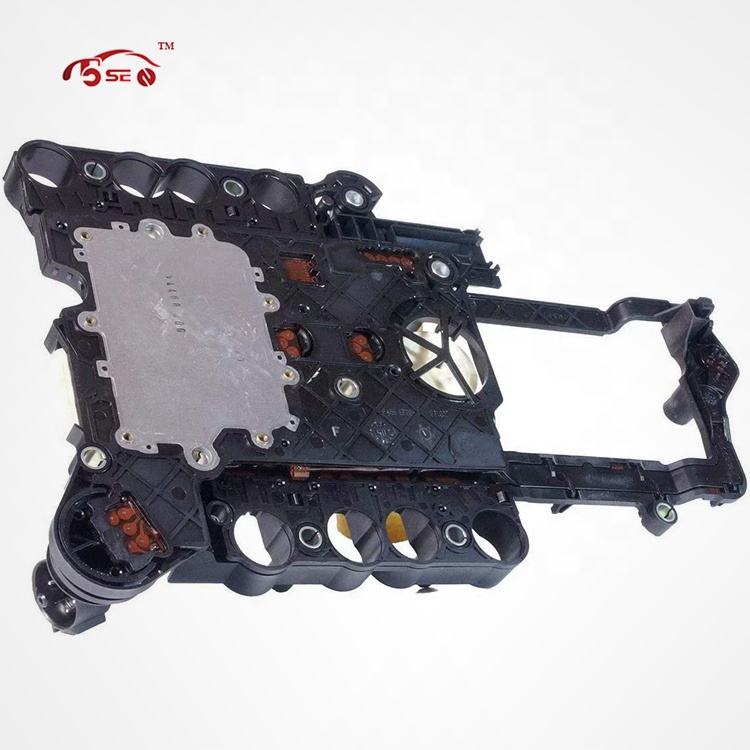
Cause 2: disturbed conductor paths to the solenoids. The same plate also provides the conductor paths linking the controller to the shift solenoids and the pressure regulators mounted on the hydraulic unit. When those paths degrade, the hydraulic unit receives interrupted or inconsistent commands, and the gearbox executes the shifts it is given with degraded precision. Here too the scan is the discriminator: a solenoid-circuit fault traced to the control interface points at the plate, while a mechanically failing valve behaves differently on inspection.
Cause 3: a servo module that no longer selects the commanded gear. A separate component executes the actual gear selection. The A0002701852 Intelligent Servo Module takes the electronic shift request issued by the transmission control unit and translates it into physical travel of the selector mechanism, so the commanded gear engages — which is why the module is described as an electrohydraulic shift actuator rather than a full transmission controller. A shift fault traced to the servo mechanism is repaired by replacing the ISM, not the controller and not the valve body — a targeted fix that only pays off when the scan has already excluded the control interface.
Cause 4: the wrong control hardware generation. A fourth cause appears after the wrong part has already been fitted. The valve body and conductor-plate hardware changed over the 722.9 production run, so two vehicles that share a model name can carry different control hardware. A replacement ordered against a model name alone can arrive with a different controller generation or electrical connector layout, and the disturbed shift quality returns because the new interface does not match the unit on the vehicle. Confirming the complete Mercedes-Benz module number and the VGS identification on the original component prevents this outcome.
Cause 5: a repair that was never finished. The fifth cause is not a failed part but an incomplete commissioning. Because the conductor plate lives within the valve body assembly, renewal of the plate requires opening the hydraulic unit, fitting fresh seals and, where required, scheduling the transmission fluid service alongside it. The surrounding transmission electronics may also require coding or adaptation after fitting, and the workshop should plan the programming and adaptation procedure appropriate to the vehicle and the replacement controller. A mechanically correct repair that skips these steps can still shift harshly.
How to Trace the Cause Before Ordering Parts
The diagnostic sequence below keeps the investigation inside the control chain and ends with an enquiry a supplier can actually verify:
- Scan first — record the stored transmission fault codes before any part is ordered, and keep the readout with the vehicle file.
- Isolate the layer — decide whether the fault sits with the speed signals, the solenoid circuits on the control interface, or the selector mechanism.
- Read the original labels — record the complete Mercedes-Benz module number and VGS identification from the conductor plate, or the reference number stamped on the original Intelligent Servo Module.
- Compare the hardware — check the connector pattern, mounting arrangement and controller generation against the removed unit before choosing a replacement.
- Scope the commissioning — plan the coding, adaptation, seal renewal and fluid service the repair requires, and write those requirements into the parts enquiry.
A model-name-only order is the most common reason for receiving a part that does not match, because the same model can carry different transmission hardware across its production run. The sequence above removes the model name from the decision and replaces it with the numbers printed on the components actually fitted to the vehicle.
Ordering the Right Part After the Diagnosis
Once the scan has isolated the faulty layer, the order itself is a data exercise. TOSEN supplies the conductor plate and the Intelligent Servo Module as new components, inspects each unit against the part number and connector arrangement before dispatch, and checks the sensor and solenoid interface on the plate. Buyers working with export volumes can request a sample for qualification before committing to a larger order. An enquiry that can be verified looks like this:
- The original module label — the complete Mercedes-Benz module number, the VGS identification, or the A0002701852 reference number.
- The vehicle identity — the VIN and the transmission code.
- Connector details — the layout, pin pattern and mounting arrangement seen on the removed unit.
- The commissioning scope — the coding or programming requirements the workshop will perform after fitting.
- The quantity and sample plan — the required quantity, and whether a sample unit is needed for qualification first.
For a repair carried out as a mechatronic assembly, confirming the wiring configuration keeps the hydraulic and electronic components matched as a set. The full range of matching controllers and plates is listed under Transmission Control Units.
Frequently Asked Questions
What causes harsh shifting on a Mercedes-Benz 722.9 transmission?
Harsh shifting on the Mercedes-Benz 722.9 seven-speed automatic is most commonly traced to the electrohydraulic control chain: speed signals lost on the conductor plate, disturbed conductor paths to the shift solenoids and pressure regulators, a fault in the A0002701852 Intelligent Servo Module, a mismatched controller generation, or commissioning work such as coding and adaptation left incomplete after a repair. A diagnostic scan that isolates the faulty layer comes before any parts order.
How does the conductor plate affect shift quality on the 722.9 gearbox?
The conductor plate carries the gearbox speed sensors and the data connector serving the transmission control unit, and the same plate routes the controller’s commands to the shift solenoids and pressure regulators of the hydraulic unit. A fault on the plate therefore appears as interrupted or implausible speed signals together with disturbed shift quality, which is why the assembly is a common repair item on the 722.9 gearbox family.
When is the A0002701852 Intelligent Servo Module the correct replacement?
The A0002701852 Intelligent Servo Module is the correct replacement when a shift fault has been isolated to the selector mechanism rather than to the control interface. The module takes the electronic shift request issued by the transmission control unit and translates it into physical travel of the selector mechanism so the commanded gear engages, and the surrounding transmission electronics may require coding or adaptation after fitting. Confirming fitment means matching the reference number stamped on the original module and checking the connector pattern and mounting arrangement against that unit.
How do I confirm the correct 722.9 replacement part before ordering?
Confirming the correct 722.9 replacement part starts with the complete Mercedes-Benz module number on the original component, supported by the VGS identification, the connector layout and the controller generation for a conductor plate, or the stamped reference number for an Intelligent Servo Module. The vehicle VIN, the transmission code and any coding or programming requirements should accompany the enquiry so the supplier can verify fitment before the order is committed.
Diagnosing harsh shifting on a Mercedes-Benz 722.9? Send the original module label, the vehicle VIN, the transmission code, the stored fault codes and the required quantity to TOSEN, and include the workshop’s coding or programming requirements so the replacement scope can be confirmed with the quotation.