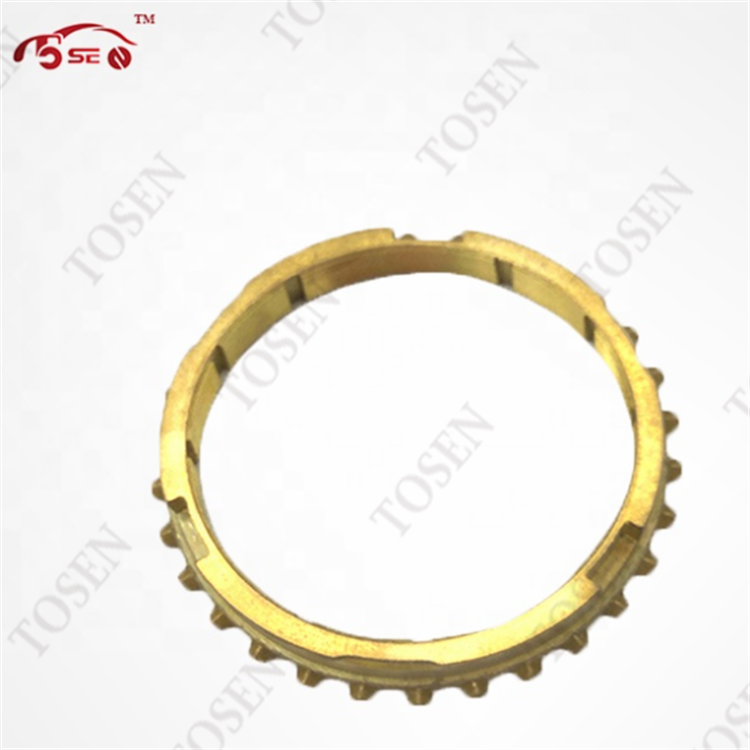
The 9-33265-610 Isuzu synchronizer ring is the small brass ring inside the 4JA1 gearbox that makes gear changes smooth instead of noisy. When it wears out, you feel it long before the gearbox fails: a crunch on downshift, a stubborn first or second gear, a gear that refuses to engage without double-clutching. This guide walks through the exact OE number and its cross numbers, what ships in a full synchronizer set, which friction material to expect, how to judge wear, and how to confirm the ring matches your 4JA1 before you place an order.
Is 9-33265-610 the Correct OE Number for Your 4JA1 Gearbox?
The Isuzu 4JA1 is the 2.8-litre diesel engine used across Isuzu pickup trucks, the Panther, and light commercials that share the same manual gearbox family. The synchronizer ring inside that box carries the Isuzu part number 9-33265-610. Buyers also meet it under related numbers such as 8-94128-610-2, 8-94465-422-0, and aftermarket cross numbers like CR006L. These are usually the same shifting part from the same gearbox family, but they are not automatically interchangeable in every vehicle — the exact variant depends on the gearbox code and model year.
Before quoting, line up three identifiers: the OE number printed on the old ring or its packaging, the gearbox code on the transmission case, and the vehicle VIN or old-part label. Suppliers that start with the VIN remove the guesswork, because the VIN resolves the gearbox variant even when the part number has been rubbed off. Do not rely on a model-name guess; the 4JA1 name covers a range of years and markets, and the ring spec can differ between them.
You can see the exact unit we build for this application on our 9-33265-610 Synchronizer Ring for ISUZU product page, which lists the 4JA1 fitment and the supplied configuration. Match the number and the gearbox family before you buy, and you avoid the most common cause of returned synchronizer rings: a wrong variant ordered from a wrong cross reference.
What Is in a Full Synchronizer Set: Ring, Cone, Hub, and Sleeve
A synchronizer ring is never the only part working during a gear change. The complete synchronizer assembly is a stack: the hub splined to the shaft, the sleeve that slides on the hub, the blocking ring — the part numbered 9-33265-610 — and in many designs a friction cone and spring or strut parts that push the ring into contact. When you open a 4JA1 gearbox for a rebuild, the question is how much of that stack to replace.
Many aftermarket sellers offer the ring as a single line item, which suits a known-good assembly where only the ring is scored. For a gearbox that has been grinding for weeks, the friction cone is usually worn in the same way and at the same time, because the two parts wear against each other. Replacing only the ring and leaving a worn cone gives you a few months of service before the grinding returns. A full synchronizer set protects the labour you already paid for.
Across our transmission catalogue we stock both single rings and complete sets, so you can order the level of rebuild you plan for — see our synchronizer rings and gearbox parts category to compare single rings, kits, and related gearbox internals before you decide.
Friction Material and Pre-Lubrication: Checks Before Installation
Synchronizer rings work by friction: the ring presses against the gear cone until their surface speeds match, then the sleeve slides through. That friction surface is why the material matters. OEM-class rings for the 4JA1 family are conventionally made from a brass or bronze-type alloy that provides a controlled friction level with enough wear life for truck service. The same part in a lower-grade material may engage with less grab, causing slower shifts, or wear out quickly under the higher torque of a loaded pickup.
Ask your supplier what material the ring is made from and whether the friction surface is machined or coated. A supplier that can state the material and the manufacturing tolerance is giving you information to judge; a listing that only says “high quality” gives you nothing to verify.
Pre-lubrication is the other cheap insurance. Eaton’s synchromesh service documentation is explicit on this point: gearbox internals, including synchronizer assemblies, must be lubricated correctly at assembly because a dry or badly lubricated gearbox damages the brass rings in a short time. During a rebuild, apply gear oil to the ring and cone friction faces before you close the box, use the correct oil grade for the 4JA1 gearbox, and follow the run-in advice in the workshop manual. This step costs minutes and protects a part that otherwise fails fast.
Gear Grinding Symptoms: How to Judge a Worn Synchronizer Ring
The classic symptom of a worn 9-33265-610 is grinding when you change into a lower gear, especially second. As the ring’s friction taper flattens, it can no longer bring the gears to the same speed before the sleeve moves, so the teeth crash. Drivers often “double-clutch” or shift slowly to mask it, which is a strong sign the ring is done.
Before you open the gearbox, check the easy things first: clutch release, gearbox oil level and condition, and engine idle speed. A dragging clutch produces grinding that feels similar but is not a ring fault. Once the clutch and oil are confirmed good, the diagnosis points at the synchronizer.
When the box is open, judge the ring on three checks. First, look at the friction cone face: a glazed, polished, or heavily grooved surface is wear. Second, fit the ring over the gear cone and press it: a healthy ring “brakes” quickly and holds, while a worn one spins free or wobbles. Third, measure or compare the ring’s tooth width against a known-good unit, because teeth that have become thin will soon break. For the same inspection logic used by transmission rebuilders, our related technical guide covers the full wear checklist and when replacement is the only correct answer.
Single Ring or Full Synchronizer Assembly: What to Order
If the goal is a quick single-gear fix in a healthy gearbox, a single 9-33265-610 ring is the right line item. If the gearbox is already open, or if grinding has gone on for a while, order the full synchronizer assembly. The deciding factors are labour cost and how long the repair must last: a gearbox you open a second time for a missed cone costs far more than the difference between a ring and a set.
Fleet workshops that standardize their rebuild process typically order complete sets for every open gearbox and keep single rings as a service line for quick repairs. Wholesale buyers get the same choice per order, with the same fitment confirmation applied to every line.
Batch Consistency for Wholesale Synchronizer Orders
Wholesale and fleet buyers depend on repeatable quality: the tenth batch of 9-33265-610 rings should be identical to the first, because a change in material or dimension silently changes the shift feel of every rebuilt gearbox. Ask the supplier how they control batch consistency — where the rings are made, what material specification is used, and whether dimensions are checked against a master sample.
For a supplier with manufacturing capability, that answer is concrete: production runs against a fixed drawing, inspection at the batch level, and the ability to hold a master sample of the OE part for comparison. That is the practical meaning of an OEM-class supply line, and it is the difference between a one-off price and a dependable source.
Frequently Asked Questions
What vehicles use the 9-33265-610 synchronizer ring?
It is the synchronizer ring for the manual gearbox family behind the Isuzu 4JA1 engine — pickup trucks such as the Isuzu Panther and related light commercials. The exact fitment depends on the gearbox code, so confirm your VIN and gearbox variant before ordering.
Is 9-33265-610 the same as 8-94128-610-2?
Cross numbers like 8-94128-610-2 and 8-94465-422-0 are used for the same shifting part family. They are usually equivalent, but not every vehicle is interchangeable on every variant. Provide the OE number and the gearbox code, and the supplier confirms the match.
Can I replace just the ring, or do I need the cone too?
You can replace just the ring in a healthy assembly, but if the gearbox has been grinding, replace the ring and cone together — they wear as a pair, and a new ring on a worn cone fails early.
Does the ring need pre-lubrication before installation?
Yes. Apply the correct gear oil to the ring and cone friction faces at assembly and use the specified oil grade, following the gearbox workshop manual. Incorrect lubrication damages brass synchronizer rings quickly.
How do I confirm the ring matches my 4JA1 before I pay?
Submit your VIN, old-part label or OE number, model year, quantity, and destination port. The supplier confirms fitment against your gearbox variant before preparing the shipment.
Get a Fitment-Confirmed Quote
Submit your VIN, old-part label / OE number, model year, quantity, and destination port to receive a fitment confirmation and a quote. The same identifiers that prove the correct 9-33265-610 ring for your 4JA1 gearbox become the records used to ship the right part — single ring or complete synchronizer set — in wooden-case packing ready for sea freight.
References
- Eaton — Light-Duty Synchromesh Transmissions Service Manual (TRSM2105): synchromesh inspection and lubrication guidance: eaton.com (TRSM2105 PDF)
- Eaton Cummins — Endurant Service Manual (TRSM0950): gearbox assembly and lubricant requirements: eatoncummins.com (TRSM0950 PDF)
- ZF Model S5-42 Inspection Information — transmission component inspection practice: charm.li (ZF S5-42 inspection)