A used transmission control module can lower the part cost, while a new module may offer a cleaner hardware history and clearer warranty. Neither route is automatically ready to install. The exact controller identity, supplied software state, approved programming path, test record and work still required on the vehicle decide whether a quote is usable.
This used vs new transmission control module guide gives workshops and professional buyers a practical comparison method. Confirm the fault and exact part first, then compare the hardware condition, preparation, whole-job cost and written warranty as separate items. The best choice is the route the workshop can verify and finish—not simply the cheapest module or the newest box.
Confirm the Fault and Exact Controller First
| Item | Description |
|---|---|
| TCM | The transmission control module. Depending on the design, it may be a separate controller or part of a larger mechatronic assembly. |
| Supply scope | The physical parts included in the quote, such as a controller only, controller with valve body, or a complete mechatronic unit. |
| Software state | What data or calibration is present when the unit arrives and what must still be completed on the vehicle. |
- Save the fault scan before clearing codes or disconnecting the original module.
- Check power, ground, network communication and relevant wiring before condemning the controller.
- Separate an electronic-controller fault from hydraulic, clutch and internal mechanical faults.
- Photograph the entire transmission and controller labels, including every suffix.
- Record the VIN, transmission code, hardware and software identification, and connector layout.
- State whether the quote must include only the controller, a valve body, or a complete mechatronic assembly.
Keep the original module available until the replacement has completed setup and a functional check. An official replacement procedure for one vehicle family tells technicians to save the old TCM part number and VIN when communication is still possible; if it is not, the correct software part number must be identified another way. That is a useful identity discipline, but the procedure itself applies only to the models named in the bulletin.
Compare Condition and Software State Separately
Condition describes the hardware history. It does not describe the delivered software, vehicle data or commissioning work. Ask every supplier to state both. A new controller can arrive blank and require initialization, while a repaired original may retain useful vehicle data. A donor-used unit can still need an approved reset or preparation route. Even a unit advertised as programmed may require configuration, basic settings or learning after installation.
| Route | Hardware history | Software questions | Proof to request | Main uncertainty |
|---|---|---|---|---|
| New, blank | No prior vehicle service | Which exact calibration and configuration are required? | Manufacturer traceability and correct application number | Workshop tools, access and setup time |
| New, supplier-prepared | No prior vehicle service | What was loaded, for which identifiers, and what remains? | Written preparation scope and unit serial or label | Meaning of “programmed” may be incomplete |
| Remanufactured or exchange | Previously used hardware rebuilt to a stated scope | Was prior data cleared and how is the target application prepared? | Rebuild scope, test record, core and warranty terms | Replaced components and exclusions vary |
| Repaired original | The vehicle's original unit with specified repairs | Which original data remains and what setup follows refitting? | Repair and test report tied to the original unit | Other transmission faults may remain |
| Donor-used | Service history depends on the donor | Can prior identity be lawfully cleared or adapted for this application? | Donor identity, test method and written compatibility path | Unknown history and unsupported reuse |
New does not mean plug-and-play
Use the applicable manufacturer procedure for the exact transmission; do not transfer one brand's sequence to another platform.
Eaton's Procision service bulletin says a new TCM must be initialized and calibrated, then lists configuration and sensor calibration steps for that product family. This is a product-specific example of why the software and commissioning scope must be confirmed separately from the module's physical condition.
Confirm the Used-Module Path Before Purchase
A matching number is necessary, but it does not prove that a used controller can be prepared for the target vehicle. Confirm the route with the technician or programming provider who will actually do the work. Give that person the donor label, original-unit data, target VIN, transmission identity and fault history before buying.
- Match the complete hardware or OE number, suffix, transmission application and supplied assembly.
- Ask whether that exact donor module and target platform are supported by the named service method.
- Confirm whether readable data from the original unit are required and whether they are available.
- Define the lawful tool, subscription, account access and power-support requirements before the appointment.
- List every task after preparation: installation, configuration, code clearing, basic settings, clutch or transmission learning, and the final road or functional test.
- The programming provider has accepted the exact donor and target identifiers in writing.
- The plan covers an original module that cannot communicate.
- Security-related data are handled only through authorized procedures.
- The workshop has the required diagnostic interface, stable power supply and network access.
- A failed preparation attempt, return and replacement are assigned to specific parties.
Official procedures show why preparation must be platform-specific. One blank-TCM bulletin requires the correct software part number, programming, configuration and code clearing. A separate heavy-duty replacement procedure includes erasing prior identity, programming vehicle information and completing transmission and clutch learning. These are examples of different workflows, not universal instructions.
Ask What Was Tested and What Remains Unknown
- Unit identity: full part number, serial or inventory number and clear label photos.
- Test method: visual inspection, communication test, bench operation or vehicle test stated precisely.
- Test conditions: voltage, connected equipment, simulated loads or donor vehicle conditions where relevant.
- Recorded result: actual observations or values, not only “tested” or “good.”
- Exceptions: functions that were not tested and faults that a bench setup cannot rule out.
- Provenance: donor application, mileage if verifiable, removal reason and storage history.
- Warranty: duration, covered failure, claim proof, return freight, labor and exclusions.
Keep claims within the boundary of the method. A controller that communicates on a bench has passed that communication check; it has not proved the condition of the target vehicle's wiring, valve body, clutches or mechanical transmission. Likewise, a repaired module report should name the repaired area and post-repair checks without implying that every related system was tested.
- Reject stock photos as proof of the quoted unit's identity.
- Ask whether the report follows the module through packing and shipment.
- Record tamper seals, installation conditions and claim deadlines before opening the package.
- If the supplier cannot describe the test boundary, price the unit as carrying more uncertainty.
Compare the Whole Job, Not the Part Price
Build a job-cost sheet instead of comparing listing prices. Use quotes for the exact vehicle, module and destination; generic online price ranges hide different supply scopes. Include the cost of a second removal, reprogramming appointment or immobilized bay if the first route fails.
| Cost or risk line | New route | Donor-used route | Question to price |
|---|---|---|---|
| Diagnosis and identity | Still required | Still required | Who confirms the failed subsystem and exact number? |
| Module and supplied assembly | Confirm controller-only or larger assembly | Confirm donor scope and transferred parts | What is physically in the box? |
| Software preparation | Initialization or programming may remain | Reset, cloning or adaptation feasibility may remain | What is completed before delivery? |
| Vehicle setup | Configuration, learning and verification may apply | The same tasks may apply, plus donor-data work | Which workshop performs each task? |
| Logistics | Freight and lead time | Freight, donor availability and return risk | When will the exact unit ship and who pays a return? |
| Core and warranty | Check claim and labor terms | Check core, exclusions and donor warranty | What happens if the installed unit fails the agreed check? |
| Repeat work and downtime | Usually lower history uncertainty, not zero risk | May add another sourcing or preparation cycle | What is the cost of one unsuccessful cycle? |
- Use the same diagnosis, installation and verification scope for every option.
- Separate refundable core charges from final cost.
- Add programming, subscriptions, towing, freight and taxes where applicable.
- Assign repeat labor and downtime instead of treating warranty replacement as cost-free.
- Compare delivery dates and workshop capacity alongside money.
Choose the Route That Fits the Job
| Situation | Lower-risk starting point | Why | Confirm before ordering |
|---|---|---|---|
| Downtime is expensive and the application is fully supported | New or documented remanufactured unit | A clearer hardware history and supply chain may reduce sourcing uncertainty | Exact identity, preparation, delivery date and warranty |
| The original unit is repairable and its data matter | Repair the original | Retaining the known unit can simplify identity and data questions | Repair scope, test boundary, turnaround and fallback |
| A new unit is unavailable but an exact donor exists | Donor-used after feasibility is confirmed | Availability may justify added preparation and history checks | Donor identity, authorized preparation, test record and return terms |
| Tools or approved programming access are limited | Supplier-prepared new or exchange route | Moving defined preparation upstream may reduce workshop uncertainty | What was completed and what still must happen on the vehicle |
| The failed subsystem is uncertain | Pause the purchase | Changing module condition does not fix an incomplete diagnosis | Power, network, wiring, hydraulic and mechanical checks |
Use constraints to choose
Choose new for a lower-history-uncertainty starting point, not as a promise of zero setup.
Choose used only when the exact donor, preparation path, test scope and fallback are accepted before payment.
Choose repair when the original unit is suitable and the repairer can define the fault, work and verification.
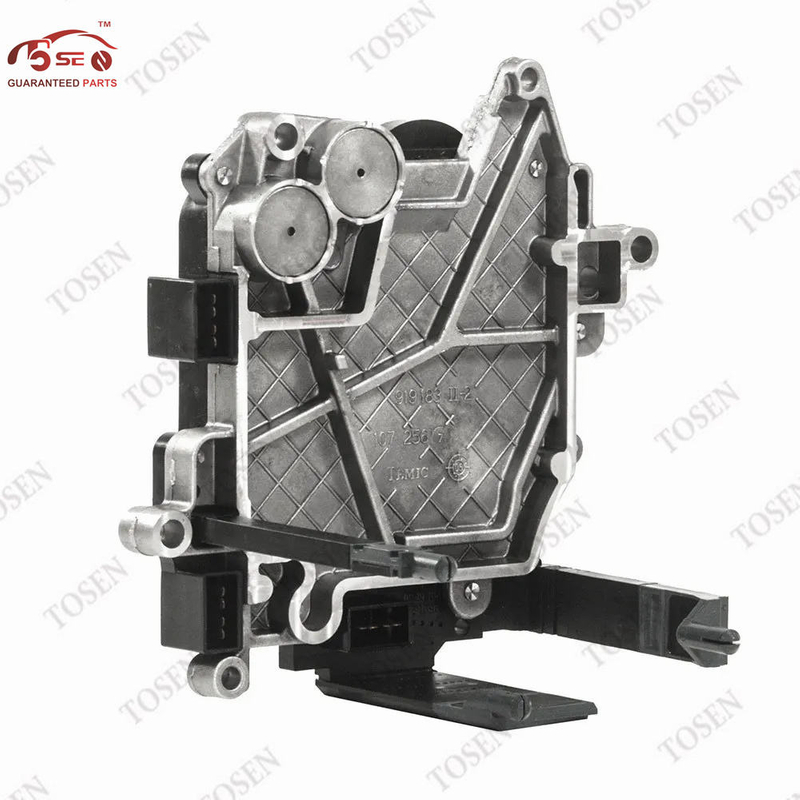
For a scoped example, TOSEN AUTO lists a new 01J927156JG module for specified Audi A4 and A6 Multitronic applications. The listing identifies the JG suffix, states a 12-month warranty and asks buyers to send the VIN, controller label, transmission code and programming requirement. That product is relevant only when those identifiers confirm the exact application; it is not a substitute for a general condition decision.
Send One Complete TCM Enquiry
- Send the VIN, make, model, year, engine and transmission code.
- Attach readable photos of the original controller and transmission labels plus the saved scan.
- Describe the diagnosis and say whether the original controller still communicates.
- Request the exact supply scope, condition and delivered software state.
- State the workshop's diagnostic tools, programming access and ability to perform required learning.
- Give the quantity, destination and required delivery date, then request written test and warranty terms.
- Quoted part number and suffix
- Controller-only, valve-body or complete-mechatronic contents
- New, remanufactured, repaired-original or donor-used condition
- Software work completed before shipment and work remaining after installation
- Unit-specific test method and exclusions
- Lead time, freight, core, return and warranty allocation
Use the 01J927156JG Multitronic Transmission Control Module for Audi page when that exact suffix and application are confirmed.
For a broader request, review the transmission control units and mechatronics range, then send the same identifier packet.
- A comparable quote repeats your identifiers, included hardware, preparation boundary and remaining workshop work.
Use the TCU and mechatronics technical guide to frame preparation and installation questions.
Frequently Asked Questions
Is a new transmission control module plug-and-play?
Not necessarily. New describes the hardware history, not the installed software state. The exact application may still require programming, configuration, initialization, basic settings or learning. Ask what is loaded before shipment and which approved procedure and tools the workshop must use afterward.
Can a used TCM be programmed to another vehicle?
Sometimes, but not universally. Feasibility depends on the exact module, platform, prior data, authorized method and access available to the technician. Have the named programming provider approve the donor and target identifiers before purchase. Do not assume a matching connector or base number is enough.
Is a repaired original TCM better than a used replacement?
It can be when the original unit is repairable, its identity and data are useful, and the repairer gives a clear repair and test scope. A donor-used replacement may be preferable when the original is beyond repair, but its history and preparation path need separate checks.
What is the most important TCM fitment detail?
There is rarely one detail. Use the complete controller number and suffix with the transmission code, VIN lookup, hardware or software identification and supplied assembly. Reconcile any disagreement before ordering, especially when the vehicle may have had an earlier replacement.
What should a used TCM warranty cover?
Ask for the duration, covered failure, required installation proof, claim deadline, return freight, replacement or refund route, labor treatment and exclusions. Confirm what happens when programming is unsuccessful or the unit fails only after vehicle setup. Keep the original packaging and test records.
Should the old TCM be returned immediately?
Usually, keep it until the replacement completes the applicable programming, learning and functional test, unless a core deadline requires a different plan. The original label and data may still be needed. Agree on the core-return timing before the replacement ships.
Choose the Route the Workshop Can Finish
A new TCM usually reduces hardware-history uncertainty; a donor-used unit may improve availability or part cost; repairing the original can preserve known identity and data. The right route is the one that matches the exact transmission, has a supported preparation method, comes with useful test and warranty terms, and leaves the workshop with a defined installation and verification plan.
Request a fitment and scope check Send TOSEN AUTO the VIN, transmission code, complete controller labels, fault scan, required assembly and workshop capability. Ask for the exact part number, condition, software state, test scope, remaining setup, lead time and warranty in one written quote. Use the relevant TOSEN product or transmission-control category page.