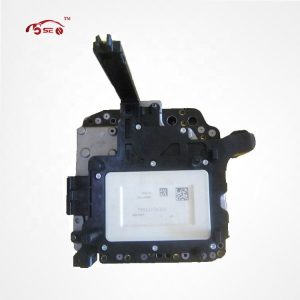
When a Mercedes 7G-Tronic starts slamming between gears or drops into limp mode, the fault is usually one of three parts: the valve body, the conductor plate mounted on top of it, or the transmission control unit. Owners and workshops have logged thousands of these failures on 2004–2014 cars, and most of the cost comes from one avoidable mistake — replacing the wrong part first. A new valve body will not fix speed-sensor faults, and a fresh conductor plate will not repair worn valve bores.
The repair gets safe when you work in order: group the fault codes, read the VGS code that decides what gets replaced together, price the job by its actual scope, and only then order. This guide walks that path for the 722.9 valve body and its two companion components, so the part you buy matches the part that failed.
What 722.9 Valve Body Failure Feels Like
A failing 722.9 valve body announces itself through shifting behavior you can feel: delays, jolts, and gears that refuse to engage. The catch is that a failing conductor plate — the electronic plate bolted on top of the valve body — produces almost the same complaint list. Treat these symptoms as the start of the diagnosis, not the verdict, because the repair you order depends on which of the two actually failed.
- Limp home mode: the car locks into one gear (often 2nd or 3rd) and refuses to shift up
- Harsh or jolting 1-2 and 2-3 shifts, especially when the transmission is cold
- A flare or rev between 4th and 5th as the shift completes late
- Delayed engagement when shifting from Park into Drive or Reverse
- Slipping: engine RPM rises without matching acceleration
- A shudder under acceleration that feels like it comes through the driveline
- Check engine or transmission warning light, often with codes P0730, P0700, P0731, P0732, or P0741
If the car drops into limp mode on the road, Mercedes specialists commonly suggest one quick trick: pull over, switch the engine off, wait about ten seconds, and restart. It clears the fault on some cars and restores shifting for a while. That restart is a temporary reprieve, not a repair — limp mode can also come from wiring, low fluid, or sensor faults outside the valve body, so the car still needs a proper diagnosis before anyone orders parts.
Valve Body, Conductor Plate, or TCU: Telling Them Apart
Three parts share one symptom list, so symptoms alone cannot tell you what to buy. The isolation works in three steps. First, scan the codes and group them: clusters dominated by speed-sensor and solenoid-circuit faults point at the conductor plate, while incorrect-ratio and pressure-related codes point at the hydraulic side of the valve body. Second, read the VGS code — the generation label on the transmission control unit, which you reach by removing the pan. Third, when the codes overlap, live transmission data settles it: a technician watches actual gear ratios and pressures against commands, and a borderline case gets a physical inspection of the valve bores before anyone orders.
| Component | Typical evidence | What it is | What you order |
|---|---|---|---|
| Conductor plate | Speed-sensor and solenoid-circuit codes; intermittent communication loss | Electronic plate bolted on top of the valve body; carries the speed sensors | Conductor plate (sensors are not serviceable separately), plus a coded TCU when the generation requires it |
| Valve body | Incorrect-ratio and pressure-regulator codes; harsh or flared specific shifts | Hydraulic control unit that routes pressure to the clutches | Valve body — stock, bore-repaired, or modified casting |
| TCU / VGS unit | Generation-dependent; replaced alongside the plate on VGS2/VGS3 paths | Transmission control unit mounted with the valve body assembly | Virgin (uncoded) TCU plus an SCN coding session to marry it to the car |
Two warnings save real money here. The speed sensors live inside the conductor plate and cannot be bought or fitted separately — when they fail, the conductor plate is the part. And reloading TCU software, however good the dealer's intentions, only smooths shifts on healthy hardware; it does nothing for worn bores or failed sensors. If the scan points both ways, the honest answer is that live data and a physical look inside decide — that is exactly how specialists avoid the double repair.
What Actually Wears Inside the Valve Body
When the scan points to the hydraulic side, this is what usually failed: the pressure-regulator and incorrect-ratio codes from the isolation step almost always trace back to four specific valve bores inside the casting, which wear out and let pressure leak where it should not. Each worn bore leaves a different fingerprint in the way the car shifts, which is why the symptom pattern matters even after the codes point you at the valve body. Transmission rebuilders catalog these wear points precisely, because the fix differs depending on which bore is damaged.
| Wear point | What it causes | Typical fix |
|---|---|---|
| K3 shift valve bore (K3 clutch applies in every gear except 4th) | Hard or abrupt shifts, delayed or missing forward engagement, harsh 4-5 shift or flare, early K3 clutch failure | Bore repair, or casting replacement where the bore is too far gone |
| K1 regulator valve bore (K1 clutch applies from 3rd through 5th) | Harsh or flared 2-3 and 5-6 shifts | Bore repair with an upgraded, more durable valve |
| Supply pressure regulator valve bore (feeds the shift solenoids) | Unusually hard or unusually soft shifts, wrong-gear starts, torque converter damage, TCC and solenoid codes | Bore repair or casting replacement, plus upgraded valve |
| Working pressure regulator valve bore (sets overall line pressure) | Poor overall performance, inadequate lubrication, overheating, premature clutch failure | Heat-damage inspection first, then bore repair or casting replacement |
Clean or replace?
Early-stage debris contamination can respond to a professional clean and recondition.
Worn valve bores, scored regulator valves, or solenoids that will not free up need replacement — no cleaning recovers lost bore surface.
Reputable rebuilders modify the casting beyond stock (re-machined bores, hardened valves) so the known wear points last longer than the original design.
The inspection result decides — ask the shop what they found in the bores, not just whether the part 'tested bad'.
VGS Generations: Which Parts Fit Your 722.9
The 7G-Tronic went into a huge slice of the Mercedes range from the early 2000s onward — service specialists list it across the C, CLK, CLS, E, SL, SLK, R, ML and GL lines — so the same valve body family serves a lot of different cars. What decides your repair is not the model badge but the generation code inside: two cars from the same year can need different parts. That is why the VGS label, not the model year, is the ordering reference.
- Remove the transmission pan (new pan gasket and one-time bolts go back on at reassembly).
- Find the transmission control unit mounted in the center of the valve body assembly.
- Read the label: VGS1, VGS2, or VGS3 — this single number decides the repair scope.
- Match the scope table below to your generation before requesting quotes.
- Order with the coding plan in writing: which parts, virgin or coded, and who performs the SCN session.
| Generation | What gets replaced | Coding requirement | Typical path |
|---|---|---|---|
| VGS1 (roughly MY2004–2008) | Valve body AND conductor plate together — the early units fail as a pair | Replacement TCU married via SCN coding | Both units plus TCU; the most expensive scope |
| VGS2 / VGS3 | Conductor plate and TCU; valve body often retained | Virgin TCU required, married to the car with an SCN coding session | Plate + TCU path; valve body only if bores fail inspection. Externally the two generations behave the same — the difference is the label version on the unit, so order by what the label says, not by any claimed feature change |
Order by part number, not by photo. The 722.9 transmission control unit is the clearest example: the A0002701852 TCU is a documented 722.9 reference part, and a supplier who can confirm fitment against your VGS generation is worth more than one who just says 'fits Mercedes'. On cost, no published guide splits the range cleanly into parts and labor — the labor is the pan-off job plus adaptation and coding, while the part price swings hardest between dealer, remanufactured, and exporter sources, so ask suppliers to quote the two lines separately.
The sourcing route changes the paperwork more than the parts. A dealer will sell restricted components against TRP paperwork — your VIN, owner details and service records; a remanufacturing specialist will sell modified units with the bores already re-cut; and a parts exporter will ship worldwide but should confirm the generation match in writing. Whether the order is the conductor plate or the control unit, get two answers before paying: does this part match my VGS generation, and who performs the SCN coding.
What the Repair Should Cost — and Include
Independent cost guides put a valve body replacement between $2,000 and $3,000 installed, and full diagnosis-to-repair jobs on these transmissions commonly land between $1,500 and $4,000 depending on how many units the generation forces into the repair. Ranges that wide only make sense once you itemize the scope — two quotes can differ by a thousand dollars and both be correct, because one includes the filter, the correct fluid, and the coding session and the other does not.
- Pan-off labor with a new pan gasket — the one-time pan bolts are torqued to specification and replaced, not reused
- New transmission filter (reference A2212770198) — mandatory with the pan down, not optional
- The correct fluid for your build: MB 236.14 (red) up to transmission serial number 2834526, MB 236.15 (blue) from serial 2834527 or with code A89 — the two are never mixed, and no third-party substitutes belong in this unit
- Fluid level set through the overflow pipe at exactly 45°C — there is no dipstick, and the temperature matters
- Adaptation routine after the new unit goes in, so the transmission relearns shift points
- SCN coding session for any replaced TCU — virgin unit married to the car
- Combined-visit pricing if both valve body and conductor plate need work: one pan-off visit costs significantly less than two
- A come-back expectation in writing: shifts smooth out over the first 100–200 miles as adaptation completes; persistent harshness after that is a warranty conversation
Use the checklist as a quote judge. A price that skips the filter, fills whatever fluid is on the shelf, or leaves coding as 'the customer's problem' is cheaper for a reason — and on this transmission those shortcuts are how the same repair ends up happening twice. Mercedes' own service information is blunt about the fluid rule, and the level-set temperature is not negotiable, so treat any deviation from that scope as a reason to keep shopping, not a discount.
Keeping the Repair Fixed: Fluid, Debris, Heat
Valve bodies rarely wear out on their own — they are killed by what circulates past them. Clutch and torque converter wear sheds debris into the pan, that debris scores the valve bores, and heat thins the fluid that is supposed to protect them. A rebuilt valve body dropped into a dirty, overheating transmission goes back to failure the same way the last one did, which is why the service around the repair matters as much as the part.
- Service the fluid and filter roughly every 40,000 miles despite the 'lifetime fill' label — Mercedes specialists who open these units regularly are blunt that old fluid is what turns into bore paste
- Use only the correct specification for your build — 236.14 or 236.15, never mixed, never substituted
- Check the pan for debris at every service: glitter or clutch material points at the converter or clutches, the upstream cause of valve wear
- Watch for converter-wear codes (around 2511 and 2783) — catching the converter early protects the valve body you just paid for
- 4Matic owners, shorten the intervals: the shared fluid loop through the transfer case runs hotter and shears faster, and rear-seal leaks are common enough to warrant regular level checks
Frequently Asked Questions
Can I keep driving with a failing 722.9 valve body?
If the car is in limp mode, treat it as undrivable for anything but a short, gentle trip to the shop — a transmission stuck in one gear can leave you stranded without warning. Harsh shifts alone give a little more margin, but every additional mile circulates debris that widens valve bore wear.
How do I read the VGS code if I don't have a lift?
The label sits on the transmission control unit inside the pan, so the pan has to come off — there is no exterior tag. Some scan tools can read the VGS generation electronically; ask your workshop to try that before scheduling the pan-drop.
Is a used or remanufactured valve body safe to buy?
Condition and generation matter more than the price. A remanufactured unit with re-machined bores and upgraded valves addresses the 722.9's known wear points; a used unit of unknown history carries the same wear you are paying to remove. Either way, require written confirmation that it matches your VGS generation.
Will a dealer software update fix my harsh shifts?
Not if the cause is hardware. A TCU update can smooth shifts on a healthy transmission, but it cannot repair worn valve bores or failed speed sensors. If the scan points at sensors or pressure faults, software is not the repair.
What happens if the wrong fluid was already in my 722.9?
Mercedes' operating-fluids service bulletin (SI00.40-P-0014A) allows one official rescue: if the wrong fluid was filled by mistake, drain it and refill with the correct specification within about 10 km of driving, and no transmission replacement is needed. Past that window the bulletin offers no drain-and-refill allowance, so a suspected cross-fill should be corrected immediately rather than at the next service.
Do I have to replace the conductor plate with the valve body?
On VGS1 units — roughly 2004 to 2008 — yes, the two are replaced together because that generation fails as a pair. On VGS2 and VGS3, the plate and TCU path usually spares the valve body, and the valve body is only opened if inspection shows bore wear.
What paperwork do I need to buy a valve body from a dealer?
Mercedes classes the 722.9 valve body as a theft-relevant part, so dealers sell it to independent shops against TRP paperwork: the owner's details, the VIN, and service records for the car. It adds friction, which is why many workshops compare a specialist or exporter alongside the dealer quote.
Order the Right Part the First Time
The whole repair comes down to sequence: group the codes, read the VGS label, match the generation scope, and judge every quote against the full job — filter, correct fluid, adaptation, coding. Do it in that order and the part you pay for is the part that failed. Skip a step and the same symptoms will bring the car back.
Buying the electronics or the plate for a 722.9? Send us your VGS generation and part number for a fitment-checked quote before you order.