A blank TCU and a pre-programmed TCU can be the same hardware sold in two very different readiness states. The right choice depends on the exact transmission controller, the data that must be transferred, the tools available at the workshop, and what the supplier has actually prepared.
This guide gives transmission shops and parts buyers a repeatable way to compare both options. It separates hardware fitment from software work, defines the questions to ask before ordering, and shows when the cheaper-looking unit can create the more expensive installation.
Blank or Pre-Programmed TCU: The 60-Second Decision
Start with workshop capability, not price. A unit described as “pre-programmed” may still require vehicle-side setup, while a blank unit may require information that cannot be recovered after the original controller fails.
| Buying situation | Usually safer starting point | Confirm before ordering |
|---|---|---|
| Original TCU communicates and the workshop can read and write its data | Blank or prepared replacement | Whether cloning, flashing, coding, or adaptation is required |
| Original TCU is dead or unreadable | Supplier-prepared unit | Which VIN, software, immobilizer, and identification data the supplier needs |
| Workshop has dealer-level or approved programming access | Either, depending on the platform | Tool coverage, subscriptions, battery support, and guided procedure |
| Workshop has installation tools but no programming equipment | Pre-programmed or cloning service | What remains to be done after installation |
| Part number or transmission code is uncertain | Do not order yet | VIN, full label, transmission code, connector and hardware revision |
Working rule: software state cannot correct a hardware mismatch. Verify the controller family first, then choose how its data will be prepared.
What a Blank TCU Actually Means
A blank TCU is replacement hardware that has not been configured for the target vehicle. “Blank” is a commercial description, not one universal technical state. Depending on the controller, it may contain base firmware but lack vehicle-specific coding, or it may require a complete software load before the transmission can operate.
- What it can offer: flexibility for shops that routinely program the same controller family.
- What it does not promise: correct software, learned values, VIN association, security authorization, or completed basic settings.
- Main dependency: a supported toolchain and the correct data source for that exact platform.
A blank unit is often a good workshop choice when the original module is readable and the technician already has a verified process. It is a poor gamble when the original unit is inaccessible and the buyer has not confirmed how replacement data will be obtained.
What Pre-Programmed Should Include—and What It May Not
“Pre-programmed” should describe completed work, not merely a reassuring label. One supplier may load the correct software version. Another may also write identification data or clone readable information from the original TCU. Neither automatically means the vehicle is ready to drive immediately after installation.
| Supplier statement | Useful follow-up question |
|---|---|
| Software loaded | Which software number and calibration were loaded for my transmission code? |
| VIN programmed | Is VIN writing the only vehicle-specific step, or is coding/security work also needed? |
| Cloned | Which memory areas were copied, and was the source TCU read successfully? |
| Unlocked or virgin | What approved commissioning procedure must the installer complete? |
| Plug and play | Are scan-tool setup, adaptations, relearn, or a road test still required? |
Ask the seller to state the delivered software condition and the remaining workshop steps on the quote. That written boundary is more useful than the phrase “pre-programmed.”
Check Hardware Fitment Before Discussing Programming
A matching vehicle model or a familiar base number is not enough. Transmission controllers can change by gearbox family, production date, engine pairing, hardware revision, connector design, and suffix. A programmed incompatible unit is still incompatible.
- Capture the VIN. Use it as one input, not as the only identifier.
- Photograph the full original label. Include manufacturer number, hardware number, software number, and every suffix.
- Record the transmission code. Confirm it from reliable vehicle or transmission identification, not only from a fault scan.
- Compare the physical unit. Check connector keying, casing, mounting points, and whether the listing is TCU-only or a larger assembly.
- Ask for written cross-reference approval. If the suffix changes, the supplier should explain why the replacement supersedes the original.
If any identifier conflicts, stop the purchase until the seller resolves it. This check prevents both wasted programming time and avoidable return disputes.
Programming, Cloning, Coding and Basic Settings Are Different Jobs
Buyers often use “programming” for every electronic step. A precise work order separates them because the required equipment, data, and failure risks are different.
| Operation | Purpose | Question to document |
|---|---|---|
| Flashing | Loads operating software or calibration | Which software package and tool will be used? |
| Cloning | Copies readable data from the original controller | Can the original TCU be read completely and verified? |
| Coding or configuration | Sets vehicle- or equipment-specific options | Is online access or a guided function required? |
| Security pairing | Authorizes the controller where the platform requires it | Who performs the approved pairing procedure? |
| Basic settings or relearn | Initializes transmission functions after installation | What scan-tool procedure and road test are required? |
Procedures vary by controller. Follow the correct service information for the vehicle and protect system voltage throughout any write operation. An interrupted flash can turn a compatible replacement into a non-communicating unit.
Confirm Whether You Are Buying a TCU, Conductor Plate or Mechatronic Assembly
The same transmission family may be sold as an electronic controller, a conductor plate with integrated electronics, or a complete mechatronic assembly with hydraulic components. Listings sometimes use these names loosely.
- TCU only: usually the electronic controller; verify seals, fasteners, and transfer parts separately.
- Conductor plate assembly: may combine sensors and electronics; confirm exactly which components are installed.
- Complete mechatronic: can include the valve body, solenoids, controller, and related hardware, but supplied scope still varies.
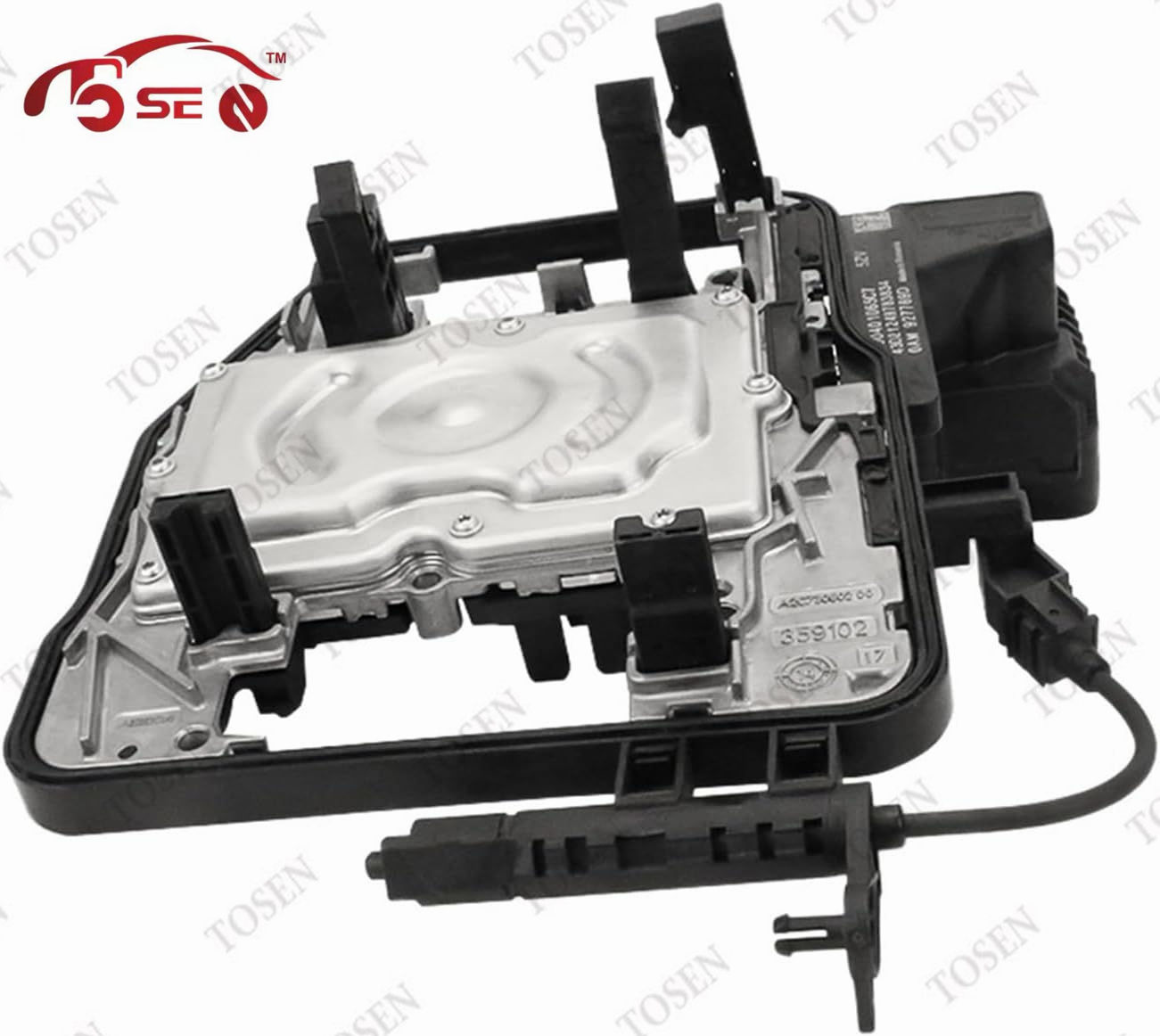
For a real product reference, review the DQ200 0AM927769D DSG transmission TCU. For broader sourcing, compare transmission control units and mechatronics. These pages show product scope; they do not replace vehicle-specific approval.
Use This Pre-Order Evidence Checklist
Send one complete evidence pack before asking for a final quote. It reduces back-and-forth and gives both buyer and supplier a clear acceptance record.
- VIN and vehicle build date
- Transmission code and application
- Clear photos of the complete original TCU label
- Original part number, suffix, hardware number, and software number
- Full diagnostic scan with fault codes and communication status
- Whether the original controller can be read
- Requested supply scope: TCU only, conductor plate, or complete mechatronic
- Requested software state: blank, prepared, cloned, or another defined state
- Workshop tools and online-access capability
- Required bench-test evidence, warranty terms, and return conditions
The technical guide to transmission control units can help non-specialist buyers align terminology with the workshop before the order is placed.
Choose the Lower-Risk Route for Your Workshop
| Scenario | Lower-risk route | Reason |
|---|---|---|
| High-volume specialist with proven read/write coverage | Blank unit with documented in-house programming | The shop controls the data path and final setup. |
| General repair shop without module programming tools | Supplier-prepared unit with a written remaining-work list | It limits unsupported bench work while preserving clear installation duties. |
| Original TCU is readable but intermittently faulty | Clone or data-transfer assessment before removal | Recoverable data may simplify replacement preparation. |
| Original TCU is dead and identifiers are incomplete | Pause and identify the transmission correctly | Guessing at hardware or software creates two failure points. |
| Fleet or distributor purchase | Sample approval before batch order | A controlled first installation validates fitment, software state, and supplier evidence. |
The lowest purchase price is not necessarily the lowest installed cost. Compare the unit, data preparation, technician time, tool access, relearn work, downtime, and return exposure as one job.
Frequently Asked Questions
Is a pre-programmed TCU always plug and play?
No. It may still need coding, security authorization, basic settings, adaptations, fault clearing, or a road test. Ask the supplier to list completed work and remaining installation steps.
Can a blank TCU be installed before programming?
Do not assume it can. Some controllers will not communicate or operate correctly until the required software and configuration are loaded. Follow the platform-specific service procedure.
Can VIN alone confirm the correct TCU?
VIN is important, but use it with the transmission code and the complete original label. Part-number suffixes and hardware revisions can change within a vehicle family.
Should the original TCU be discarded after replacement?
Keep it until the replacement is installed, commissioned, road-tested, and accepted. The original may contain useful identification or recoverable data and can help with diagnosis or return documentation.
Send the Right Data Before You Buy
Choose blank or pre-programmed only after confirming hardware fitment and the exact software work required. The safest quote is the one that names the supplied assembly, delivered software state, remaining workshop steps, test evidence, and warranty boundary.
For a TOSEN AUTO fitment review, send the VIN, transmission code, full original label photos, diagnostic report, and whether the original TCU can still be read. We can then confirm available supply scope and preparation options before you order.