Carbon fiber synchronizer ring pre lubrication comes down to one rule: the carbon lining must meet the gearbox's own oil before its first shift. The lining is a thin carbon-fiber friction layer bonded to a metal ring, and it is built to work oil-wetted. A dry first engagement is not a break-in period for this material — it is damage.
This guide is for rebuild benches and parts buyers working with carbon-lined rings. It covers what the lining actually is, why it depends on oil, which fluid and method the documented instructions use, what a dry or wrongly-oiled ring does to a rebuild, and the six checks that make the next assembly or wholesale order safe.
What a Carbon Fiber Synchronizer Ring Is
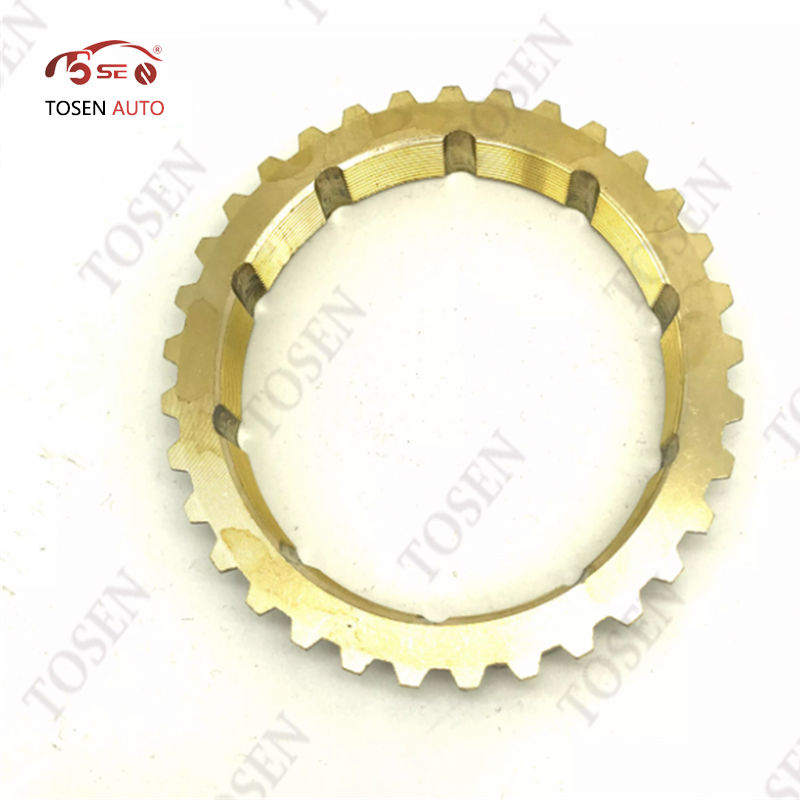
A carbon fiber synchronizer ring is not carbon all the way through. It is a metal ring body — brass, steel, or a steel-and-brass composite — with a woven carbon fiber friction layer bonded to the cone surface, the face that rubs against the gear's cone during every shift. Patent filings for this ring class document the layer at 0.2 to 0.6 mm thick: carbon fiber fabric set in resin, heat-treated at 900 to 1200 °C, then glued to the metal body with an adhesive that resists both oil and heat.
The "carbon fiber" in the name refers to that lining, not the whole part. Gearbox makers adopted it because a carbon friction face holds its friction coefficient higher and steadier than the machined brass surface it replaces, keeps that behavior across a long service life, and tolerates more heat. The material appears in manual and dual-clutch passenger gearboxes, in performance rebuilds, and in some truck boxes — the New Venture NV4500 5-speed used behind GM and Dodge trucks runs carbon fiber lined center friction rings on its first and second gears, where shifting loads are heaviest.
| Feature | Brass ring | Carbon-lined ring |
|---|---|---|
| Friction face | Solid brass alloy, machined into the ring itself | Thin woven carbon layer bonded to a metal ring body |
| How it wears | Sacrificial metal wear; the face polishes and thins with use | Lining wears slowly; friction stays stable until the layer is damaged |
| What it asks of oil | A wiped oil film at assembly protects a metal-to-metal pair | Designed to hold oil inside its porous matrix — the documented instructions call for wetting or soaking before assembly |
That last row is what this guide is about. The two ring types do not ask the same thing of the oil can on your bench, and treating them as if they do is where dry-start failures begin.
Why the Carbon Lining Depends on Oil
Carbon synchronizer linings are wet-friction materials by design. Friction-material makers list oil compatibility as a core property of the carbon grades used for synchronizer rings, and the patent documentation describes the carbon layer working with transmission oil moving across it during engagement. In plain terms: the lining was never meant to touch a cone dry. Its friction behavior and its cooling both depend on oil being present in the contact.
The mechanism is the porous structure. The woven carbon matrix holds a film of oil inside itself, and during a shift that oil steadies the friction between ring and gear cone while carrying heat away from the contact band. A dry carbon face does not become "extra grippy" in any useful way. Instead, the first engagements generate localized hot spots that scuff and damage the carbon matrix. Racing build documentation, where shifts are hardest and failures show fastest, describes exactly this failure on synchros installed without their oil.
This is why the old brass habit undersells the job. A brass ring is one material through and through, so wiping it with oil at assembly is anti-scuff insurance for a metal-on-metal pair. A carbon-lined ring is a composite that expects oil in its friction path from the first tooth. Pre-lubricating a carbon lining is conditioning the material into its working state — not just protecting it while the gearbox fills.
How Pre-Lubrication Is Done
The fluid rule comes first because it decides everything after it: use the transmission oil your gearbox's own service documentation specifies, and nothing else. The synchromesh manual practice is representative — the Eaton synchromesh transmission service manual TRSM2105 directs that parts working under friction are lubricated with the same transmission oil during assembly, from the same specification the gearbox will run. Whatever the bottle, if it does not match the spec printed for your gearbox, it is not assembly lube for this ring.
Before the methods, one fluid-category caution. API GL numbers describe an oil's extreme-pressure additive level, not its thickness or quality — a higher number is not an upgrade. GL-5 axle oils carry a much heavier sulfur-phosphorus EP dose — a figure commonly quoted at roughly double GL-4's — which is what hypoid differential gears need and what many brass-bodied synchro assemblies cannot safely run. In a synchronizer unit, that heavier EP chemistry risks corroding the yellow metals and disturbing shift friction, so where the manual specifies GL-4, GL-4 is what enters the box — and the same rule runs the other way for axles that need GL-5. Dual-rated GL-4/GL-5 oils with yellow-metal-safe chemistry exist; the data sheet, not the shelf label, is what clears them.
| Category | Built for | Synchronizer caution |
|---|---|---|
| API GL-4 | Manual gearboxes and transaxles with moderate EP needs | The common synchromesh category; the safe default where the manual names it |
| API GL-5 | Hypoid axles and heavily loaded differentials | Roughly double the EP additive; can attack brass and bronze bodies and alter shift friction in a synchromesh unit |
| Dual-rated GL-4/GL-5 | Oils whose chemistry is certified safe for both duties | Acceptable only where the data sheet states yellow-metal safety and meets the spec'd category |
With the right bottle on the bench, the method depends on what the instruction for your gearbox actually says — and the honest answer is that different documented sources specify different depths of pre-lubrication, each in its own context.
| Context | The instruction | Where it is documented | Applies to |
|---|---|---|---|
| General synchromesh assembly | Lubricate every part that works under friction with the gearbox's own transmission oil during assembly | Synchromesh service-manual practice | Any rebuild that follows its model's manual |
| Truck gearbox with carbon-lined rings | Soak the rings in the gearbox's specified GL-4 manual-transmission fluid before assembly | Ring-supplier instruction for the NV4500 5-speed | Carbon-lined rebuilds where the supplier or manual names a soak |
| Performance and racing builds | Fully saturate carbon synchros in the exact gear oil the car will run — a 24-hour soak is the practice racing build guides name | Racing gearbox build practice | Track use, where shift loads are highest; a context label, not an OEM spec |
| OEM assembly plants | Rings are soaked in gear oil before assembly, and the soak time is set per ring type from test data | Gearbox-plant engineering study of synchronizer ring pre-lubrication | Proof that soak duration is a real, tested process variable — not a folk number |
When no instruction exists for your gearbox, the defensible default is simple, and it is the same logic every documented instruction above shares: the entire friction face must be wet with the specified oil before the case closes, and nothing but that oil should touch it on the way in.
- Work from a clean tray with the specified oil only. The lining should never pick up grease, parts cleaner, or a different grade on its way into the case.
- For the wipe standard, wet the whole friction face of the ring — the full cone contact band, not a dry patch left in the middle — using clean oil and a lint-free cloth.
- If your documentation calls for a soak, submerge the rings fully in the specified oil and agitate them until the air bubbles stop rising off the friction face, then hold them for the duration that instruction names.
- Drain the excess briefly — the face should be wet, not dripping — and carry the ring straight to the case. Do not let it dry on the bench while you work on the next part.
- Do not bench-shift or dry-run the assembled unit before its oil fill. The first engagement is the one that has to happen wet.
That practice map settles the duration question honestly: no universal soak time is defensible across gearboxes, because a gearbox-plant study of synchronizer ring pre-lubrication set its soak times per ring type through testing. Your transmission manual or your ring supplier's instruction is the only number with authority for your gearbox. Where both are silent, the wipe rule still stands as the minimum — the lining must at least be wet with the specified oil before the case closes, and the first shift must never meet a dry carbon face.
What Dry or Wrong-Oil Assembly Causes
The failures announce themselves in two signatures. First: grab, grind, or notchy resistance on the very first shifts after a rebuild, before the gearbox has had time to wet itself. Second: shifts that turn labored and heavy weeks or months later, with no teardown in between. The first signature points to what happened at assembly; the second points to what is sitting in the case. If the symptoms started long before any rebuild, the synchronizer ring wear symptoms guide walks the diagnosis from first noise to verdict.
A dry carbon lining takes the worst of the first signature. The friction face meets its cone without the oil film it was built around, so the contact band runs hot in spots instead of spreading load — the failure mode racing builders report on synchros installed dry: localized hot spots that permanently damage the carbon matrix. A separate dry failure hits even brass-lined units: a gearbox that is bench-shifted or shipped completely dry can let the rings screw themselves onto the microscopic machining threads of a new gear cone and jam, leaving the box apparently stuck in two gears. Workshop inspection guidance for production gearboxes makes the same point about dry assembly: dry or improperly lubricated synchromesh parts wear early and shift hard. The ring and its cone work as a pair in that jam, and the ring versus cone versus sleeve identification guide keeps the three look-alike parts straight while you trace it.
| What you see | Likely cause | What it costs |
|---|---|---|
| Grab or grind on the first shifts after rebuild | Friction surfaces met dry — pre-lubrication skipped | Scuffed lining with hot spots; possible immediate re-teardown |
| Labored, notchy shifting weeks after rebuild | Wrong oil in service — e.g., a GL-5 where the manual specifies GL-4 | Lining contamination or yellow-metal corrosion; synchro set replacement |
| Gearbox jammed, seems stuck in two gears | Unit shifted or shipped bone-dry; ring screwed onto a machined cone | Teardown to free the ring, cone polish or part replacement |
Wrong-oil damage is chemical, which is why it shows up late — and why the fluid-category rules earlier in this guide are written the way they are. The active sulfur in heavy-EP gear oil attacks the organic fibers inside a friction lining, breaking down the bond that gives the material its grip, and a lining contaminated that way does not clean back to new — replacement is the fix. The same chemistry etches brass and bronze bodies in a synchromesh unit. Either way, the first visible symptom is a gearbox that simply shifts worse, and by the time it is loud, the parts are already done.
What to Verify Before Assembly or a Wholesale Order
Memory is not a quality control. The rebuild-floor convention that holds up across gearbox families is the written record: reference number, gearbox model, friction material, lubricant spec and quantity, recorded together, checked together. Run the checklist below before the bench opens, not after a comeback.
Every point maps to a field a supplier can confirm before anything ships. The synchronizer ring supply pages in the transmission parts category are built around exactly this exchange: a listing verifies the reference number and the application against the enquiry before a quote moves forward, and the same record settles material, quantity and lubricant questions for a wholesale batch.
One listing page shows the pattern in full. The 46767057 C510 third and fourth gear synchronizer ring listing works exactly this way. If you are sourcing elsewhere, hand the same six fields to whoever holds the order.
- Get the friction material in writing. Ask for the spec sheet that names the lining — brass, steel, or carbon. A supplier who cannot name the material cannot stand behind its lubrication requirement.
- Match the lubricant before you order. Write down the gearbox's own spec — commonly a GL-4 or the OEM's manual-transmission fluid — and never let an axle-oil substitution fill the assembly record.
- Confirm fitment against the OE number and gearbox model. Stamped number, model and gear position checked against the listing before any quote, the same pass that catches wrong rings before they ship.
- Define the set and the batch. One position or a full synchronizer set, and — for a wholesale order — every ring in the batch matched to the same reference sample in dimensions and friction material.
- Ask for the pre-lubrication instruction. A supplier making material claims has, or can get, the assembly instruction for that lining. Put it in the order record next to the material spec.
- Inspect on arrival, before the bench. Lining intact and un-scuffed, no transit dings on the friction face, the right ring in the box — then wet or soak it per the recorded instruction.
None of these checks is expensive, and together they close the loop that this guide opened: the material defines the lubricant, the lubricant defines the method, and the record keeps both honest from the first shift to the next order. The ZF synchronizer ring wear inspection guide applies the same record-first discipline on the inspection side of the bench.
Frequently Asked Questions
Is the whole synchronizer ring made of carbon fiber?
No. The ring is a brass or steel body with a thin bonded carbon lining — typically 0.2 to 0.6 mm — on the cone face. The carbon is the friction material, not the structure; the body carries the spline teeth.
Does pre-lubricating the ring replace filling the gearbox with oil?
No. Pre-lubrication conditions the friction surfaces for the first shifts, before splash lubrication reaches them. The gearbox still gets its full, specified oil fill before the unit runs. One step protects the first engagement; the other keeps the whole assembly alive.
Can I pre-lubricate with any gear oil already on my shelf?
No. Use the category your gearbox's manual names — commonly GL-4 in synchromesh units. A GL-5 axle oil carries a far heavier extreme-pressure dose that risks the synchro parts, and a dual-rated oil is acceptable only when its data sheet states the specified category.
Can I use assembly grease instead of gear oil on a carbon lining?
Follow the instruction your manual or ring supplier gives, which for carbon linings is the gearbox's own oil. Sticky assembly lubes have their place on metal-to-metal fits and long storage, but a carbon friction face expects the oil it will run in — grease changes what the lining sees on its first shift.
My rebuilt gearbox was bench-shifted dry and now it is jammed. What do I do?
Set the shift levers to neutral, feed oil into the unit, insert a yoke in the output shaft, and rock the input shaft back and forth while turning the yoke so the oil reaches the rings. Repeat until the shafts turn independently. A unit that shifted dry needs the friction faces inspected before it runs again.
Do synchronizer rings arrive pre-oiled from the supplier?
Generally no — rings ship dry, which is exactly why the wetting or soaking instruction belongs to your assembly step, not the supplier's packaging. Record the supplier's pre-lubrication instruction with the order and run it at the bench.
How do I keep pre-lubrication consistent across a wholesale batch?
Make it part of the order record: one written instruction covering the same fluid spec, the same method and duration from the supplier, and a sample from each batch inspected on arrival. Batch consistency in treatment is checked the same way as batch consistency in dimensions.
Close the Loop at the Bench and the Order
One rule carries the whole guide: a carbon lining is an oil-wetted friction material, so the gearbox's own oil meets it before the first shift, by the method and duration your manual or ring supplier documents. Brass and carbon rings do not ask the same thing of your oil can, and the failure signatures — early grab, late labored shifts — both trace back to that difference. The six-point checklist turns the rule into a record that survives the next teardown and the next order.
Run the six-point checklist before your next rebuild or order: friction material in writing, lubricant spec matched to the gearbox, OE number and model fitment confirmed, set and batch defined, the supplier's pre-lubrication instruction recorded, arrival inspection done. The synchronizer ring listings in the transmission parts category take these fields directly — the 46767057 C510 synchronizer ring page confirms fitment before an enquiry moves forward. If your current supplier is holding the order, hand them the same six fields.