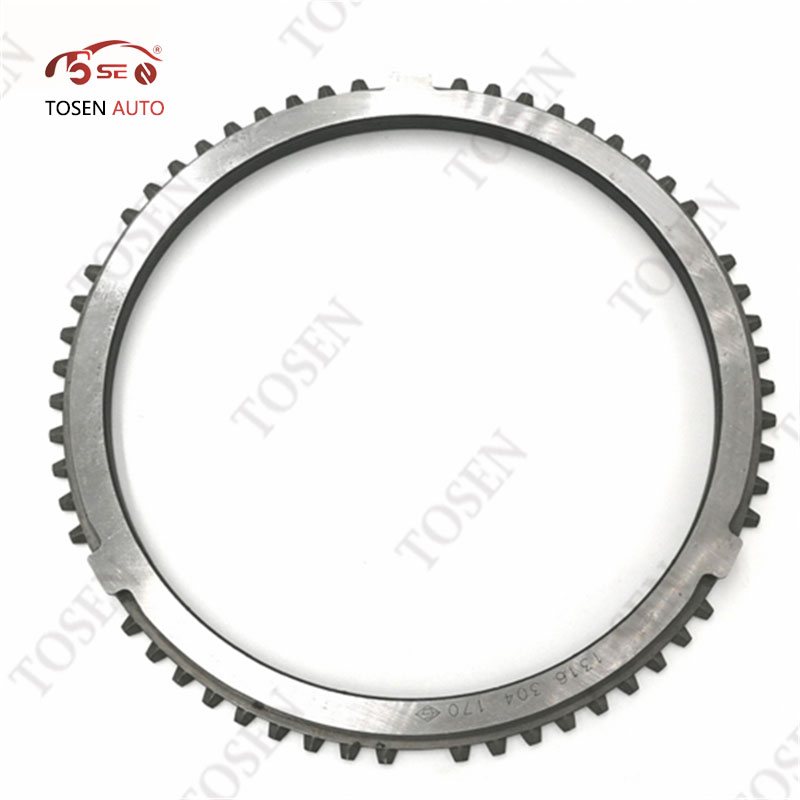
A ZF synchronizer ring wear inspection answers one question before money changes hands: is this ring actually worn out? Four repeatable bench checks give you that verdict in minutes, not a guess. The same findings then become the order spec for the replacement.
This guide walks the full sequence for a ZF truck gearbox synchronizer ring: how to prepare the part, the check-by-check inspection, how to read the results against the right wear limit, how to make sure the ring is the part at fault, and a buyer checklist that turns your findings into a confirmed order.
What a Bench Inspection Settles — and What It Cannot
The inspection produces a documented verdict you can act on and defend. Eyes alone are not enough. Workshop documentation for a production gearbox instructs mechanics to measure the gap between the synchronizer ring and its gear with feeler gauges rather than judge by sight. Eaton's service manual for its own light-duty synchromesh transmissions goes further and calls a careful inspection of every part essential to gearbox life. The checks in this guide follow that same measured approach for the ZF synchronizer ring.
One honest limit comes first. No universal wear limit for ZF truck synchronizer rings is published in the public sources a buyer can check, so the number that condemns a ring must come from the service documentation for your own gearbox model. Clearance figures published for passenger-car gearboxes do not transfer, no matter how often forums repeat them. Where this guide quotes a figure, it states exactly which model the figure belongs to. The road symptoms that justified the teardown in the first place — grinding, clashing, hard cold shifts — are mapped to their causes in the synchronizer ring wear symptoms guide, and the bench checks in this guide turn that diagnosis into a defensible verdict.
What you will have at the end
A worn-or-serviceable verdict backed by named checks, not an opinion.
A fault attribution that confirms the ring, the hub, the sleeve or the clutch.
An order spec a supplier can match: reference number, geometry, set, quantity.
Prepare the Ring: Cleaning, Handling and Records
- Wash the ring in a solvent bath and dry it fully. A film of old oil, grit or clutch dust on the cone surface fakes the wear signs you are about to look for, so judge only a clean part.
- Handle it gently from this point on. Drops and bumps on a synchronizer assembly can damage it, and damage created at the bench fakes a finding the gearbox never gave you.
- Photograph the ring from three angles before any tool touches it, and write down the reference number and the gear position it came from while the teardown is still fresh.
The records step earns its place at the start, and so does the handling warning. That Eaton service manual warns that drops and bumps during disassembly or assembly can make synchronizer parts malfunction, so keep the ring on a soft, clean surface between checks. The ring you prove worn is the ring you will order against, and the photos you take now are the ones that confirm the replacement later. A supplier who receives the reference number, the gear position and pictures of the original can match cone profile, engagement teeth and dimensions in one pass.
The Ring Inspection Sequence, Check by Check
Work through four checks in order on the clean, dry ring. Each check produces one observation, and each observation has a physical reason behind it. The ring is the friction and timing element of its synchronizer position: pressed against the mating cone during a shift, it closes the speed difference before the sleeve engages. If you are still deciding whether the part in your hand is the ring, the cone or the sleeve, the ring vs cone vs sleeve identification guide sorts the three look-alike parts before any measurement begins.
- Inspect the cone friction surface, the inner taper that faces the gear. A serviceable ring shows sharp machining grooves or hatch across the whole face. A worn ring shows the same surface polished flat and shiny, because the grooves have been rubbed away at the contact band.
- Inspect the engagement teeth around the ring's outer edge and the lugs or notches that key the ring to the hub. Look for rounded tooth chamfers, teeth thinned in the axial direction, and notches widened by years of key contact. A ring whose lugs no longer time it to the hub cannot do its job even if the cone still grips.
- Press the ring onto the mating gear cone by hand and turn it. A serviceable ring drags with obvious friction resistance as the grooves bite through the oil film. A worn ring spins easily, the same free turn a polished surface gives you.
- Measure the ring-to-gear clearance with a flat feeler gauge. With the ring pressed firmly onto the gear cone, gauge the gap between the ring's teeth and the gear's dog teeth, and write the number down. This is the figure your verdict stands on.
| Check | Worn ring shows | Serviceable ring shows |
|---|---|---|
| Cone friction surface | Polished flat and shiny; grooves gone at the contact band | Sharp grooves or hatch across the full face |
| Engagement teeth and lugs | Rounded chamfers, thinned teeth, widened notches | Sharp chamfers, full teeth, tight lug fit |
| Press-on turn test | Spins easily with little resistance | Obvious drag that resists the turn |
| Feeler-gauge clearance | Gap below the limit documented for the gearbox model | Gap at or above the model's documented limit |
The reason each sign matters is the same. The fine grooves on the ring's cone cut through the oil film between ring and gear cone to build friction. Wear them flat and the ring can no longer equalize the speeds before the sleeve moves, so the gearbox grinds into that gear. The chamfers on the ring teeth block the sleeve until the speeds match; round them off and the ring loses both its timing and its protection against clash. Workshop documentation for a production gearbox walks mechanics through exactly this kind of measured, component-by-component check, and the turn-and-measure method it uses is the one described above.
Reading the Results: Worn or Serviceable?
Three findings condemn a ring on their own: a friction surface polished flat, a free-spinning turn test, or a measured clearance below the limit documented for your gearbox model. Any one of them means the ring cannot generate the friction a shift depends on, and a replacement is due. Two of the three you can see and feel at the bench; the third needs the number from your model's service documentation, which is why the feeler gauge earns its place in the sequence.
Be strict about which number you compare against. Public sources quote minimum clearances only for the specific gearboxes they describe — the figures below are examples of that scoping, not limits for a ZF truck ring. The correct limit for a ZF synchronizer ring comes from the service documentation for your gearbox model or from the overhaul standard your shop applies to that model — in practice, ask the ZF service partner or dealer for the model's synchronizer ring wear limit, or read it from the model's overhaul standard, before you condemn a ring on any other number.
| Item | Description |
|---|---|
| 0.8 mm minimum clearance | A published workshop manual specifies this minimum between blocking ring and gear for named gears of one passenger-car model, and says to replace the gear, not just the ring, when a NEW ring still cannot reach it. |
| 0.7–1.5 mm standard gap | An aftermarket service guide quotes this standard range, with a 0.5 mm replacement limit, for the passenger-car lock-ring synchronizers it covers. It applies to those units only. |
| ZF truck ring limit | No universal figure is published in the public sources a buyer can verify. Use the limit in ZF's service documentation for your gearbox model — never a transplanted passenger-car number. |
The new-ring test closes a trap the raw measurement opens. If a brand-new ring pressed onto the same gear still cannot reach the documented clearance, the gear cone has worn, not the ring — and ordering a second ring will not fix it. The same published workshop rule applies at your bench: measure against the gear the ring actually mates with, and let the new-ring result decide whether the gear comes out too.
Replace the ring now if
The cone surface is polished flat and the grooves are gone.
The ring spins freely on the cone under hand pressure.
The measured clearance is below the limit documented for your gearbox model.
Is It Really the Ring? Cross-Checks Before You Order
Run one split before the parts list: does the gearbox grind in every gear from a standstill, or in one gear only? Grind in every gear points at the clutch dragging or not fully releasing, and the fix is hydraulics or clutch work, not synchronizer parts. Grind in one gear points at that position's synchronizer. That Eaton service manual lists clutch malfunction ahead of synchronizer causes in its hard-shifting table for exactly this reason — prove the clutch releases before you condemn a ring on its behalf.
| What you observe | What it usually points to | What to confirm next |
|---|---|---|
| Grind in every gear from standstill | Clutch drag or incomplete release | Clutch hydraulics, pedal travel and release bearing before ordering parts |
| Grind in one gear only | That position's synchronizer ring | The four ring checks in this guide |
| Rounded spline or key-slot wear, hub rocks on the shaft | Synchronizer hub | The hub bench inspection in the site's ZF hub guide |
| Sleeve teeth chipped, blunt or with worn lock stops | Sliding sleeve | Sleeve tooth and stop inspection; replace the assembly if teeth are damaged |
| New ring still shows low clearance on the gear | Worn gear cone | Gear cone condition; replace the gear per the workshop rule |
The neighbor checks have their own guide so this one stays on the ring. For the hub's own bench signs — spline wear, keyway polishing, rocking on the mainshaft — the synchronizer hub inspection guide covers the same measured checks on the 1316304163 ZF hub as its worked example.
The Buyer Checklist: From Findings to a Correct Order
A complete ring order has three layers: identity, geometry and plan. Identity is the reference number and the gearbox model; geometry is what proves the number; the plan covers set, quantity and lubricant. The 1316304170 synchronizer ring for ZF transmissions product page runs the same logic from the supplier side: each enquiry is verified against the reference number, the gearbox model and the assembly identification before a quote is issued.
- Reference number read from the gearbox documentation or the removed part — 1316304170 for the ZF ring position this guide uses as its worked example.
- ZF gearbox model and assembly identification for the position the ring came from.
- Geometry against the original ring: cone profile, engagement teeth and measured dimensions.
- Gear position and ring count: single ring or a full set, decided by the model's service guidance and the wear you measured on the stack.
- Quantity and batch consistency requirement if you are ordering for several rebuilds.
- Lubricant plan: the oil specification for your gearbox model, checked against the ring's brass or bronze friction material.
- Records to send with the enquiry: photos of the original ring and its mating components, plus your inspection numbers.
The set question deserves its own honesty. That Eaton service manual instructs mechanics to replace the synchronizer ring set — never a single part — when repairing those assemblies, and some positions use stacked rings where a missing member stops the rebuild outright. Aftermarket single-ring supply is normal, real practice, and a legitimate choice when the rest of the stack measures fine. The rule that keeps you safe: follow the service documentation for your gearbox model, and when the model is silent, weigh the cost of a second teardown against the set.
The lubricant line is on the checklist because a wrong oil re-creates the failure you just paid to fix. Gear oils with extreme-pressure additive packages formulated for hypoid differentials can attack brass and bronze rings in some gearboxes. The specification for your model decides, and the shop that rebuilds the gearbox should see the oil decision in writing before the ring goes in.
A complete order spec, at a glance
One reference number, verified against the removed part.
One gearbox model and assembly identification.
One geometry match: cone profile, teeth, dimensions.
One decision: single ring or set, per the model's documentation.
One quantity with batch expectations, one lubricant specification, one set of photos.
When the Replacement Ring Arrives
- Match the delivered ring against your records: reference number, cone profile, engagement teeth and dimensions, all compared with the original ring you photographed and measured.
- Inspect the finish: sharp grooves across the cone face, sharp tooth chamfers, no dents, flat spots or transit damage anywhere on the part.
- Count the set: if a set was ordered, every member is present before the gearbox goes back together.
- Pre-lubricate the ring and every other friction surface with the transmission oil specified for your gearbox model before assembly.
The pre-lubrication step is an assembly instruction, not a suggestion: that Eaton service manual directs mechanics to lubricate every part under friction with the same transmission oil during assembly. The arrival pass matters because a wrong or damaged ring found at install time costs the whole rebuild window, while the same ring found at unboxing costs a phone call. Keep the original's photos next to the new part and the check takes under a minute.
Frequently Asked Questions
Which wear limit applies to a ZF truck synchronizer ring?
The limit published in ZF's service documentation for your specific gearbox model. No universal ZF truck figure is public, and passenger-car minimums like the 0.8 mm one workshop manual specifies for its named gears never transfer to a truck ring. If your documentation is silent, treat your own measurement of a new ring as the reference.
Should I replace one ring or the whole synchronizer ring set?
Follow your gearbox model's service guidance first. Some OE manuals for their transmission families instruct replacing the ring set when one ring is replaced, and stacked-ring positions need every member to complete the rebuild. Single-ring replacement is normal aftermarket practice when the rest of the stack measures fine — decide on your measured findings, not on the part price.
Can I reuse a slightly worn ring?
A ring that still drags on the turn test and measures at or above your model's limit can technically be reused, but a ring going back into a gearbox you are already paying to open is a poor economy. A worn cone surface, free turn, or below-limit clearance means replace it now.
Can I judge the ring without a feeler gauge?
The press-on turn test gives a solid first verdict — obvious drag means the friction grooves still work, a free spin means they do not. But the clearance measurement is the number your decision stands on, and published workshop procedure measures the gap with feeler gauges, so borrow the gauge for the final call.
What oil is safe for brass synchronizer rings?
The oil your gearbox model's specification names. Some extreme-pressure gear oils formulated for hypoid differentials can attack brass and bronze rings in some gearboxes, so the model specification decides — write the oil decision into the rebuild order before the new ring goes in.
What if a new ring still shows a low clearance on the gear?
The gear cone has worn. A published workshop rule for one production gearbox replaces the gear when a NEW locking ring cannot reach the correct clearance, and the same logic holds at your bench — a second ring will not close a gap the cone itself has opened.
Why do suppliers ask for photos of the old ring?
Because the reference number alone cannot show cone profile, engagement teeth or dimensions. Photos of the original ring let a supplier desk catch a wrong-position order before it ships — which is the cheapest place for an error to stop.
Order the Ring Your Inspection Proved
The inspection sequence, the limit rule and the checklist are one workflow: check the ring with the measured method, prove which part is actually worn, and order against the evidence you recorded. The 1316304170 synchronizer ring product page takes the checklist fields directly — reference number, gearbox model, assembly identification, geometry, quantity — and the rest of the transmission parts range covers the neighboring components if your cross-checks point past the ring.
Send your inspection findings — reference number, gearbox model and assembly identification, geometry and dimensions from the original, gear position, set decision and quantity — through the request-a-quote form on the 1316304170 product page for a fitment-confirmed quotation. If you are not ordering yet, take the completed checklist and your records to your supplier so the same fields drive whatever order you place.