A complete differential assembly supplier in China is safe to order from when you control the evidence, not when the catalogue looks right. The method runs in four moves: define the exact assembly with counted axle data so every supplier quotes the same unit, audit the supplier with tests you can run from email, put MOQ, price, lead time and warranty on one comparable basis, and send a quote packet that makes the supplier's own reply prove whether they know differentials.
The reason the method matters is the failure mode it prevents. A differential with the wrong tooth combination for your axle can run quietly for weeks before the rest of the drivetrain pays for the error. That mistake is cheap to prevent with an axle plate photo and a counted gear set, and expensive to discover after a sea crossing, so every step below is built to catch it before money moves.
Define the Assembly Before You Compare Suppliers
A complete differential assembly order is defined by the physical axle in the truck, not by the model name on the brochure. One truck line is built with several tooth combinations across its years and axle options, so two trucks with the same badge can sit on different final drives. Before any supplier conversation, collect the data that pins down your exact unit — every check that follows depends on it.
| Order datum | What it tells the supplier | What it prevents |
|---|---|---|
| Axle plate or stamping photo | The axle model and ratio the manufacturer fitted | Guessing from the truck name, year badge or body style |
| Crown wheel and pinion tooth counts | The final-drive ratio, computed as ring teeth divided by pinion teeth | A wrong-ratio unit that meshes quietly and fails weeks later |
| Axle-shaft spline count | Which side gears and shafts the assembly must accept | A correct-ratio unit that cannot drive the wheels |
| Mounting pattern | Where and how the carrier bolts into the housing | A unit that cannot be seated in your axle housing |
| Input flange details | How the propeller shaft connects — diameter and bolt pattern | A unit that needs a driveshaft change to install |
| Scope: complete assembly or bare gear set | Whether setup work happens at the supplier or in your workshop | Paying for one scope and receiving the other |
The ratio row deserves a closer look, because the wrong-ratio failure is quiet. When the final drive does not match the axle, the speed relationship between the engine and the wheels is wrong: the speedometer drifts, the engine runs at the wrong revs for the road speed, and on a four-wheel-drive truck the transfer case absorbs the difference every mile. The damage builds for weeks before anything sounds wrong, and the repair that finally surfaces costs multiples of the part that caused it. Tooth counts on the removed unit, checked against the axle plate, are what stop this before an order exists — the numbers take minutes to collect and settle the question a model name never can.
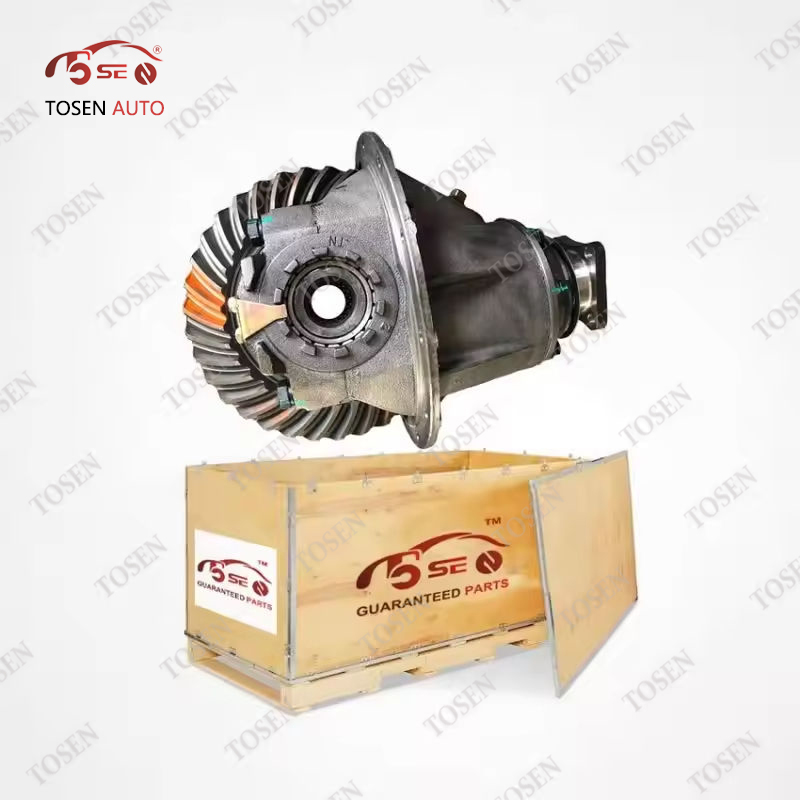
The last datum, scope, changes what you are actually buying. A complete assembly arrives with the crown wheel and pinion fitted to the carrier, side gears in place and bearings set — the setup work is done before shipment. A bare gear set ships the matched pair alone, and the shimming, bearing preload and tooth contact correction move to your workshop. A crown wheel and pinion is one matched working pair, not two parts, so whichever scope you choose, the pair must be treated as a unit through the whole order.
- Photograph the axle plate or stamping close-up, in place on the housing
- Count the pinion teeth and the crown wheel teeth on the removed unit, and divide ring by pinion to confirm the ratio
- Count the axle-shaft splines and photograph the shaft end
- Measure the mounting pattern and the input flange — diameter and bolt circle
- State the scope in writing: complete assembly, or bare crown wheel and pinion set
Audit the Supplier Before Discussing Price
Audit a differential supplier by testing what they produce, not what they claim. A complete assembly earns its price at setup: the backlash between the meshing teeth, the tooth contact pattern and the bearing preload are created when the gear pair is installed in the carrier, and they decide whether the unit runs quiet for years. So the audit asks one question in several forms — can this supplier show evidence of the setup on the unit they will actually ship?
- Do they ask for your axle data before quoting? A supplier who quotes a complete assembly without tooth counts and splines is pricing a catalogue page, not your axle
- Will they provide a per-unit inspection record for the shipped assembly — counted tooth numbers, a backlash reading, contact-pattern or run-in evidence — tied to that serial unit, not a brochure?
- Are core and return terms stated in writing before payment, including who pays freight on a return and what condition the old unit must arrive in?
- Do they describe crating for sea freight — how the cast-iron assembly is supported, dunnaged and protected for weeks in a container?
- Do their production signals hold together: per-model catalogue depth across truck lines, and setup-level documents for the axle lines they quote — backlash ranges, torque values, setup sheets a working factory uses on the floor?
The per-unit record is the strongest single test because a reseller cannot fake it well. A trading company forwards catalogue photos; a factory that sets up assemblies can send the counted teeth, the backlash figure recorded at setup and photographs of the marked contact pattern for the unit in the crate. A record that arrives with setup-level detail — backlash ranges and torque values for your axle line — reads like a workshop document, not a brochure, and that difference is exactly what you are auditing for.
The same logic separates real specialists from general traders. A supplier whose range runs model-deep — Toyota, Isuzu, Mitsubishi and Dongfeng axle lines each with their own tooth combinations — is organised around axles, and their quotation desk will behave like it. A general parts trader lists everything from differentials to mirrors; nobody on that desk is setting backlash. When your scope is a bare gear set rather than a complete assembly, the audit tightens further: ask how the matched pair is lapped, marked and kept together, because a crown wheel and pinion split from its mate is a rebuilding project, not a part.
Put MOQ, Price, Lead Time and Warranty on One Basis
Differential quotes from different suppliers rarely arrive on the same basis, and the lowest number is often the narrowest scope. A price quoted for a bare gear set without crating or core terms is not comparable to a landed price for a complete assembly with inspection records and export packing. Before comparing anything, force every quotation onto the same rows — the unit price is the last thing you compare, not the first.
| Term | Restate every quote as… | Why it changes the real price |
|---|---|---|
| Assembly completeness | Complete assembly vs bare crown wheel and pinion set, stated in the offer | Setup labour, bearings and carrier parts sit inside the complete-assembly price |
| Core and return terms | Credit for the old unit, return freight paid by whom, accepted condition | A core charge can swing the effective unit cost by a large margin after delivery |
| Crating and packing | Export crating described and included, or excluded and priced | A cast-iron assembly shipped loose risks damage that becomes your claim |
| Delivery terms | The agreed point where cost and risk transfer, applied to your port | Freight, insurance and unloading costs move the landed total |
| Lead time | Weeks to your destination port, stated as stock on hand or a production run | A stock unit and a made-to-order batch are different offers at the same unit price |
| Warranty boundary | What is covered in writing, and what voids it | The same 12-month wording can cover workmanship only, or include setup — different values |
MOQ works the same way: ask what the minimum applies to, because the answer changes your order shape. A per-SKU minimum on one tooth combination is hard for a shop that needs two units; a per-shipment minimum across mixed platforms is reachable, because a fleet order consolidates naturally — a few Hiace assemblies, an NPR unit, a Canter batch and a rear differential assembly for Dongfeng EQ145 trucks can travel in one container to the same destination port. A supplier holding deep stock across those platforms is built for exactly that consolidation, and the quantity ladder they quote should be per consolidated shipment, not per part number. Ask for the price at two or three quantity levels, on the same scope rows, and the real economics appear.
Build the Quote Packet That Tests the Supplier
The quote packet is where the audit stops being theory. One enquiry, sent to every candidate supplier, carrying the same axle data in the same order — and each reply becomes a graded test paper. The packet below mirrors what a real assembly enquiry contains on a supplier's desk, from vehicle identification to destination port.
- State the vehicle and axle: truck model and year as context, then the axle plate or stamping photographs as the reference — the plate outranks the badge
- Give the counted gear data: crown wheel teeth, pinion teeth, and the ratio you computed from them
- Add the interfaces: axle-shaft spline count, mounting pattern, input flange diameter and bolt pattern
- Fix the scope and quantity: complete assembly or bare crown wheel and pinion set, units per platform, and whether the order consolidates several truck lines
- Name the destination port and ask for the quote on one basis: crating included, core terms stated, delivery point defined, lead time given as stock or production weeks to your port, warranty boundary written
- The reply restates your tooth counts and splines, not just a price
- The reply states what ships with the unit — inspection record, crating, any accessories — in plain sentences
- Core and return terms are fixed in writing inside the quotation
- The warranty boundary says what is covered and what voids it
- The reply states lead time honestly — stock on hand or a production run, with weeks to your port
- Questions come back about your axle, not about your budget
A generic reply is a failed audit, whatever the price on it. A price for a complete differential assembly quoted without your axle data means nobody checked the tooth combination — the exact wrong-ratio failure this workflow exists to prevent, now discoverable before payment instead of after installation. A reply that restates the counted teeth, states what ships with the unit and fixes core terms and warranty in writing is the one that can be ordered from. TOSEN runs this flow every day for differential assemblies and gear sets: send the packet through the enquiry channel on the differentials category, and the reply you get back is the fitment-confirmed quotation this article has been building toward.
Receiving, Installation Handover and Claim Ownership
The order's evidence trail does not end at payment — it ends at installation, and what you do on arrival decides whether a dispute can be settled at all. The window where you can prove what shipped, versus what was claimed, stays open only until the unit goes in. Spend an hour on arrival checks and the whole order stays verifiable.
- Photograph the crate and wrapping before opening — sea-freight damage claims start with the unopened packaging
- Count the crown wheel and pinion teeth on the delivered unit against the numbers in your order
- Match the inspection or backlash record that shipped with the unit to the serial or batch marking on the assembly itself
- Keep the photo trail through installation: old unit out, new unit in, marking photos at each step
Claim ownership is decided by the warranty boundary you fixed before ordering, which is why it belongs in the quotation and not in an argument after a noise appears. A boundary worth having states what the supplier covers — workmanship and setup on a properly matched axle — and what voids it, typically installation damage or an application the axle data never supported. When the boundary is written and the arrival photos exist, a whining unit is a documented claim with a clear owner; when neither exists, it is one side's word against the other's across a border. Send the packet, fix the boundary, keep the photos — and the claim never needs to happen.
Frequently Asked Questions
Can I get a correct quote without the old unit out of the axle?
Partly. Photograph the axle plate or stamping in place and record the truck model and year, and a supplier can narrow the candidates. But the counted tooth combination only becomes certain with the unit out or a rotation check done, so treat a pre-removal quote as provisional and confirm the counts before payment.
Will a Chinese supplier sell one complete assembly, or is MOQ always required?
It depends on how the minimum is defined. A per-SKU minimum can block small orders, but many suppliers set the minimum per consolidated shipment, so one assembly alongside other parts in the same container clears it. Ask which type applies before comparing prices.
What is a backlash record and why should I ask for one?
It is the measured free play between the crown wheel and pinion teeth, recorded when the assembly was set up. It proves someone actually set the gear pair rather than loosely assembling it, and it gives you a baseline to check the same measurement on arrival before installation.
The supplier asked for photos of my old differential. Is that normal?
Yes, and it is a good sign. Photos of the axle plate and the removed unit give the supplier the same view your workshop has, which is how a fitment-confirmed quotation gets made. A supplier who never asks for them is quoting from a catalogue page.
How do I judge quality claims like OEM-grade on a listing?
Ask for the evidence behind the word: the per-unit inspection record, the backlash and contact-pattern proof, and the warranty boundary in writing. Established manufacturers in this trade publish their production and quality process; a bare grade adjective without records is marketing, not a specification.
What documents should the quotation itself contain?
Your restated tooth counts and splines, the scope (complete assembly or bare gear set), crating description, core and return terms, the delivery point and lead time stated as stock or production weeks to your port, and the warranty boundary with what voids it. A quotation missing any of those rows is not yet comparable, whatever the price says.
Order on the Evidence, Not the Catalogue
Every safeguard in this workflow comes down to one habit: make the supplier work with your axle's facts. The truck name does not settle the ratio; the tooth counts do. A catalogue photo does not prove the setup; the per-unit inspection record does. And a headline price does not compare; the restated scope does. A reply that ignores your counted teeth has already told you what a shipment from that desk would look like.
Send your differential enquiry to TOSEN with the packet from this guide: axle plate photographs, counted crown wheel and pinion teeth, axle-shaft splines, mounting pattern and input flange, scope, quantity and destination port. The reply restates your axle data and returns a fitment-confirmed quotation for the complete assembly or gear set your trucks actually carry.