Differential backlash symptoms — a clunk when you snap the throttle, a knock on direction changes, a whine that grows on the overrun — point to one measurement: the small rotational play between the meshed crown wheel and pinion teeth. That play is set with carrier shims when the gear set is installed, and a dial indicator held against the ring gear turns a suspicion into a number you can act on. It takes about twenty minutes with the cover off, and it decides whether your axle needs a shim correction, a new gear set, or a complete replacement unit.
This guide walks the full path a workshop follows: what the symptoms mean, what else makes the same noises, how the backlash check is performed and read, and how to turn the measurement into the right replacement decision for your shop's capability.
What Backlash Is and Why Your Differential Needs It
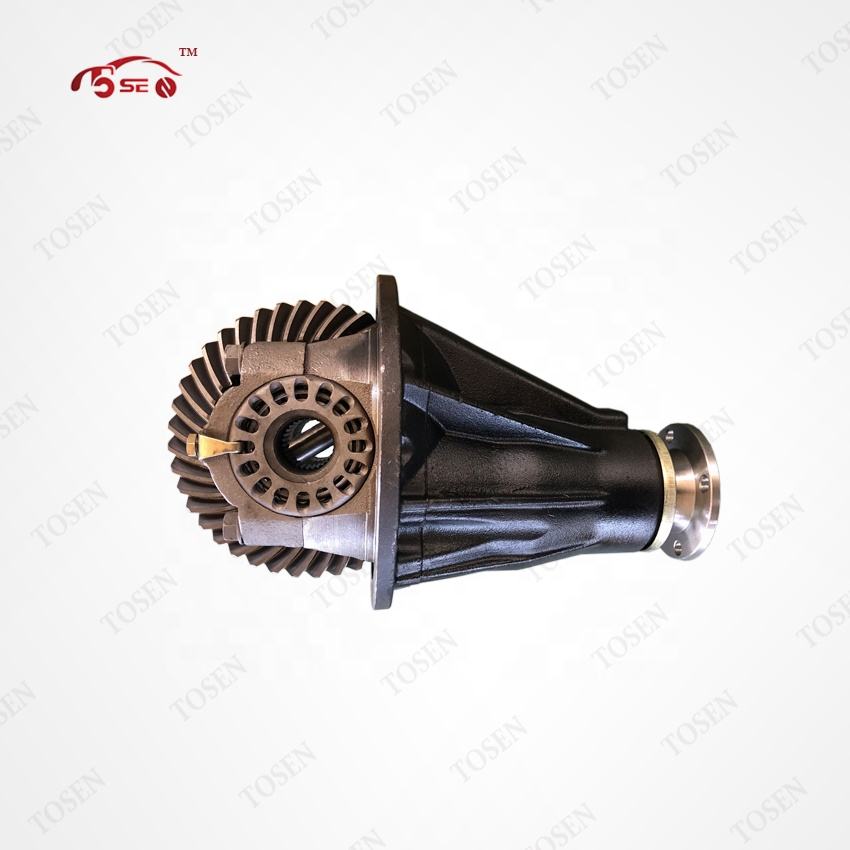
Backlash is the small amount the crown wheel can rotate before its teeth touch the pinion teeth, when the pinion is held still. Every hypoid gear set needs this working clearance. It leaves room for a lubricating oil film between the tooth faces and for the metal to expand as the axle heats up under load.
| Item | Description |
|---|---|
| Differential backlash | The free rotational play between meshed crown wheel and pinion teeth, set with carrier shims during gear-set installation and checked with a dial indicator against the axle's own service specification. |
Both wrong directions cause damage, just in different ways. Too little backlash and the teeth bind: friction builds heat, the oil film collapses, and the gear surfaces scuff and wear fast. Too much backlash and the teeth slam into each other every time the throttle opens or closes: you hear the clunk, and the impact loading chips the tooth edges over time. Neither condition fixes itself, and neither shows up in the gear oil until the damage is already done.
Symptoms That Point to Backlash — and What Mimics Them
Backlash trouble announces itself through the driveline, and the timing of the noise tells you the most. Play in the mesh shows up when torque reverses — the instant you snap the throttle open or lift off, or the moment the load flips between forward and reverse. Read the table below against what you actually feel from the driver's seat before concluding anything.
| What you notice | What it usually points to | What it rules out | What it means for the repair |
|---|---|---|---|
| Metallic clunk when you snap the throttle on or off | Excessive backlash — the teeth slam through the clearance at each torque reversal | Wheel bearings and tires — they do not respond to throttle | The mesh clearance needs measuring before any parts are ordered |
| Heavy knock or growl that gets worse under steady load | Backlash too tight or collapsing bearing preload | Loose backlash — too much play clunks, it does not growl | Stop driving and check; tight mesh overheats and destroys the oil film |
| Driveline thump when changing direction (reverse to drive) | Loose backlash, or wear in the U-joints or axle splines | Nothing by itself — this is the ambiguous symptom | Measure backlash before blaming the gear set |
| Whine that tracks road speed, steady throttle | One of several gear-noise causes; backlash is on the list but not the leader | A pure backlash fault — it usually clunks more than it whines | Use a noise-localization guide before teardown |
| Whine that appears mainly on the overrun (throttle closed) | Excessive backlash — the gears rattle through clearance on deceleration | Drive-side tooth damage — that whines under power instead | A strong backlash suspect; confirm with a measurement |
Three other worn parts copy the backlash clunk, and each fails a simple test that backlash fails differently.
- Worn U-joints clunk on takeoff and on gear changes regardless of road speed, and you can feel play by rocking the driveshaft by hand with the wheels chocked — a backlash fault hides inside the housing and cannot be felt there.
- Slip-yoke and axle-spline wear gives a single soft thump when you stop and pull away, felt once per direction change rather than on every throttle snap.
- Axle-bearing hum stays constant with road speed and ignores the throttle completely, while backlash noise follows every change in torque.
Work through the mimics first. They cost minutes to check with the vehicle on the ground; a differential inspection costs an oil drain, a gasket and half a day on the lift. And if what you hear is a whine rather than a clunk, start with a rear differential whining noise guide — it separates gear whine from bearing and tire noise before anyone opens the cover.
Causes of Wrong Backlash
Wrong backlash always has one of four origins, and the calendar is the fastest way to tell them apart. A gear set that ran quiet for eight years and started clunking has a different problem — and a different repair bill — from one that whined from the first drive after a replacement.
- Setup error at installation. Backlash is set with carrier shims, together with bearing preload and pinion depth, when the gear set goes in. Get any of the three wrong and the axle makes noise from the first drive. Whine that starts immediately after a gear-set replacement points here first, before anyone blames the parts.
- Wear after high mileage and overloading. Teeth and bearings wear, the carrier shifts micrometer by micrometer, and the clearance you measure keeps growing. Fleets that run overloaded on rough roads see this earliest; the noise and the readings grow together over months.
- Bearing failure or lost preload. When a carrier or pinion bearing collapses, the ring gear drops toward or away from the pinion and the backlash changes with it. This cause often shows up as uneven readings around the ring — the signature that separates it from simple wear.
- Mixed gears from different sets. Crown wheel and pinion are manufactured and finished as a matched pair. Combine a ring gear from one set with a pinion from another, and no shim stack will ever produce a quiet, correctly loaded mesh.
One more factory practice matters here: even the shims from the old set rarely transfer. New gears and bearings sit at slightly different depths, so every new gear set gets measured and set up from a fresh baseline — the old shim stack is a starting hint, never an answer.
How to Check Backlash the Way a Workshop Does
The check needs a dial indicator with a magnetic base, the differential cover off, and about twenty minutes. It is the same procedure whether you run it yourself or hand this list to the workshop that will, because the numbers it produces decide what you buy.
- Chock the wheels, put the transmission in neutral, and remove the differential cover over a drain tray.
- Bolt the magnetic base to the housing and set the indicator plunger square against the face of a ring gear tooth — perpendicular to the tooth surface, not angled.
- Hold the pinion still. Either lock the flange with a bar or have a second person grip the driveshaft; if the pinion rotates, you are measuring driveline slack, not backlash.
- Rock the ring gear back and forth by hand. The total needle travel between the two stops is the backlash at that tooth.
- Repeat at four to eight points spread around the ring gear, re-seating the plunger each time. Record every reading.
- Compare the average reading and the point-to-point spread against your axle's own service specification.
- If the axle is hot from a road test, let it cool before judging the numbers — clearance measures smaller when the housing is at operating temperature, typically by a few hundredths of a millimetre (.001 to .002 inch).
| Item | Description |
|---|---|
| Subaru rear differential (VA type) | 0.10 – 0.15 mm (0.0039 – 0.0059 in), measured with the dial gauge on the crown gear tooth face while holding the drive pinion. |
| Dodge 216FBI front axle | 0.12 – 0.20 mm (0.005 – 0.008 in), verified at eight points around the ring gear. |
| MT22/23 driven front axle (Klingelnberg toothing) | 0.15 – 0.25 mm, measured at four diagonal points with the pinion locked. |
| New gear rings, US Army TM 5-4210 | 0.15 – 0.41 mm (0.006 – 0.016 in); used gears are reset to the value recorded before disassembly. |
Notice what the table does not say: one universal number, and none of your trucks. Every manufacturer sets its own range for its own axles — those four rows come from other vehicles' manuals purely to prove how far the spread runs. Light-truck hypoid axles work in the same order of magnitude, but the specification for your Hiace, NPR or Fuso lives in that vehicle's own service information, keyed to the axle code stamped on its plate — never in a single figure quoted on a forum.
The spread between your readings matters as much as the average. Factory procedures allow only about 0.05 mm of variation from point to point around the ring. A uniform reading that is simply too large is a shim correction. An uneven one — 0.10 mm here, 0.25 mm there — points at runout, a bent case or damage, and no amount of shimming will average it away. That single distinction saves buyers from paying for a setup on a unit that needs parts.
Reading the Contact Pattern Alongside the Number
The backlash number tells you how much the gears move; the contact pattern tells you where the teeth actually touch. A thin coat of gear-marking compound on a few ring gear teeth, then rotating the gears against each other, prints a footprint that reads like a witness statement — and it is the evidence a workshop or supplier will photograph and send you.
- A centered footprint, mid-tooth in both directions, on the drive side and the coast side: a healthy mesh, whatever the noise source turns out to be.
- Contact bunched toward the heel (the outer, large end of the tooth): the mesh is too loose — excessive backlash.
- Contact bunched toward the toe (the small inner end): the mesh is too tight — insufficient backlash, with the highest risk of tooth chipping under load.
- Contact pushed high or low on the tooth face: a pinion depth problem, not a backlash problem — a different adjustment entirely, and usually a fuller teardown to correct.
Used gears follow different rules. A high-mileage set normally shows a polished pocket toward the toe that tails into a contact line along the tooth root — that is wear, not necessarily a bad setup, and factory practice is to reset such a set to the backlash and pattern recorded before it was dismantled, not to chase a new-gear pattern on worn teeth. When you receive pattern photos from a workshop or a supplier, judge them against these shapes, and always ask for both the pattern photo and the dial-indicator number that was recorded with it.
Backlash Readings and the Replacement Decision
Once the number is on paper, the route follows from three questions: is the reading out of spec, are the gears and housing sound, and can your shop set up a hypoid gear set? The honest answers sometimes mean buying nothing.
| Your situation | The route that fits | What it assumes | Trade-off |
|---|---|---|---|
| Reading in spec, pattern centered, still noisy | Stop — look elsewhere: wheel bearings, tires, driveline joints, oil condition | The measurement was done with the pinion locked | Costs another hour of diagnosis, saves a gear set you did not need |
| Reading out of spec, spread under ~0.05 mm, gears and pattern healthy | Shim correction — carrier shims reposition the ring gear; the gear set itself stays | A shop that can open the axle, swap shims and re-check backlash and preload | Least parts cost; the axle is opened twice if the diagnosis was wrong |
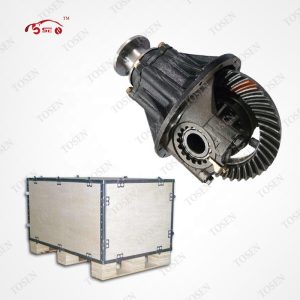
| Reading out of spec, worn or pitted teeth, scoring on the flanks | New crown wheel and pinion set with bearings and seals | A sound housing, and a shop that can set backlash, preload and pinion depth on the new set | Setup becomes your responsibility; a mis-set new set whines from the first drive |
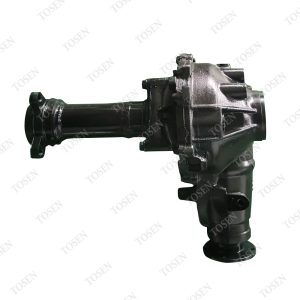
| Reading out of spec or unknown, uneven readings, tired bearings, or no setup capability in-house | Pre-verified complete differential assembly | The supplier documents tooth counts, backlash and contact-pattern checks before dispatch | Higher unit price; the setup risk moves to the party with the bench and the records |
The third row deserves a hard look before you commit. Buying a gear set transfers the two adjustments that decide whether the axle runs quiet — backlash and preload, proven by the contact pattern — onto your workshop. Run the capability check first, then price both routes — differential assemblies and gear sets.
- Dial indicator with a magnetic base, and someone who reads it on gear teeth, not brake discs
- Shim pack or adjusters for your axle type, plus a micrometer to verify shim thickness
- Gear-marking compound and the discipline to read the pattern, not just the number
- At least one person who has set up a hypoid crown wheel and pinion before
- Time for the full loop: set, measure, correct, re-measure, and a gentle break-in with an early oil change on a new set
If any line in that checklist fails, the gear-set route buys you a whine, not a repair. When the teeth themselves are scored or pitted, the parts answer is a new crown wheel and pinion set with bearings and seals. And a complete assembly that a supplier has already set up, measured and documented — the same backlash, pattern and tooth-count values a good workshop records on installation — moves the setup risk to the bench that has the tools.
What to Send Before Ordering a Replacement
A backlash diagnosis ends with an order, and the order is only as safe as the evidence behind it. The ratio stamped on the axle plate or ring gear — tooth counts such as 9 by 41 — is what actually identifies the unit you need; the noise description is not. Photograph the facts and let the supplier confirm them before anything ships.
- A photo of the axle plate or the tooth-count stamp on the ring gear (for example a 10 by 41 marking)
- Photos of the old unit, including the tooth faces that carry the contact pattern
- Your dial-indicator readings, with the points around the ring where they were taken
- The VIN or the OE part number of the vehicle or axle
- The application and load profile: vehicle model, typical payload, road conditions
Then ask for the mirror image of that evidence on the way back. A supplier shipping a tested complete differential — for example a 100% tested Toyota 10/41 unit — should be able to show the tooth counts on the ring gear it is shipping, the backlash that was measured, and the contact-pattern check, before the box leaves. That exchange, photos and numbers both ways, is what turns a backlash measurement into a confirmed-fit order instead of a return shipment.
Frequently Asked Questions
Can differential backlash be too tight, or is tighter always better?
It can absolutely be too tight. Zero or near-zero clearance lets the teeth bind, builds heat, collapses the oil film, and scuffs the tooth surfaces within a short mileage. The correct backlash is a specified working range, not the smallest number you can achieve.
Is there one universal backlash specification for all axles?
No. Each manufacturer publishes its own range for each axle — the examples in this article alone span roughly 0.10 mm to 0.41 mm depending on the axle and whether the gears are new. Always use your vehicle's own service specification, and treat any single figure quoted without a vehicle reference as suspect.
A clunk when pulling away — is that always backlash?
No, and it is one of the most misdiagnosed noises. Worn U-joints and slip-yoke or axle-spline wear produce a very similar takeoff clunk. Rock the driveshaft by hand and check the joints first; backlash play hides inside the housing and can only be measured with the cover off.
Can I reuse the old shims when fitting a new gear set?
Rarely. New gears and bearings sit at slightly different depths than the old ones, so the old shim stack almost never lands the new set in spec. Keep the old shims as a starting baseline, but expect to measure and build a fresh stack for the new set.
Why does backlash measure smaller when the axle is hot?
Thermal expansion. As the housing, gears and carrier reach operating temperature the clearance closes slightly, so a hot reading runs smaller than a cold one. Judge against the specification under the same temperature condition the manual states, and let a road-tested axle cool before comparing cold numbers.
My backlash reading is large — does that mean the gear set is worn out?
Not by itself. A uniformly large reading on healthy teeth is a shim correction. What condemns parts is a large reading combined with worn or pitted tooth faces, or readings that vary more than about 0.05 mm around the ring — the variation points at runout, case damage or bearing collapse rather than a setup value.
Can backlash be corrected without opening the differential?
No. The shims or adjusters that set backlash sit inside the housing, so at minimum the cover comes off and the oil drains. Be suspicious of any fix that promises otherwise.
From a Measured Verdict to a Confirmed Order
A backlash complaint is only worth money after the dial indicator has had its say. Rule out the joints and splines first, then get the pinion locked and the readings taken around the ring — the number, the spread and the contact pattern together tell you whether the answer is a shim correction, a new gear set, or a complete unit someone else has already set up and documented. Whichever route the verdict points to, order it with evidence: tooth-count photo, readings, VIN or OE number.
Confirm fitment before you order: Take the check list and the evidence list from this guide, then confirm your ratio and application on the Differentials category or the 100% tested Toyota 10/41 differential product page at TOSEN AUTO.