A crown and pinion supplier in China is worth ordering from when the proof arrives before the payment does. The test is what the supplier puts in writing at the quotation stage: a real gear maker asks for the markings and tooth counts of your old gears, confirms those counts in the quotation, and photographs the actual matched pair it intends to ship. That exchange tells you more than any listing page, because a crown wheel and pinion set carries no vehicle identification of its own — your measurements are the order, and the quotation is the only record of what was agreed.
This guide delivers the four artifacts the title names: supplier audit signals that separate gear makers from resellers, the specification list that defines your exact gear pair, plain answers on MOQ and pricing, and a quote checklist you can copy into your next enquiry. The risk they prevent is the expensive one: a wrong-ratio or unmatched set that installs quietly, then whines months later when the evidence trail matters most. Work through in order; the checklist at the end pulls everything into one email you can send.
What You Are Actually Ordering: A Matched Gear Pair, Not a Differential
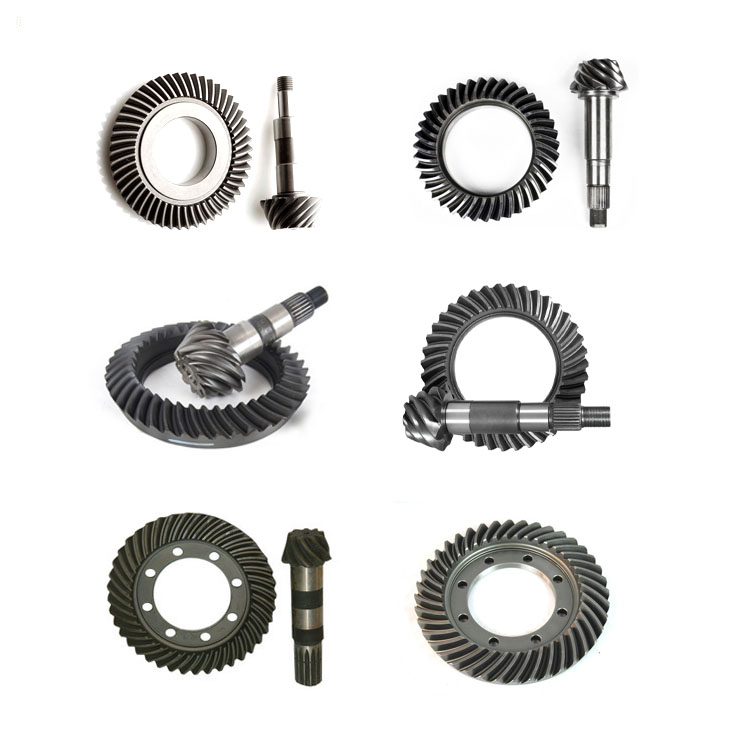
A crown wheel and pinion order is for two parts, not a unit. The crown wheel is the large ring gear that bolts to the differential case; the pinion is the small gear that takes drive from the propeller shaft. Together they set the axle's final-drive ratio, carry the full driving load, and turn the drive through ninety degrees on its way to the axle shafts. They are machined as a matched pair, so they are supplied together, priced together, and installed together — never mixed with gears from another set.
| Item | Description |
|---|---|
| Crown wheel and pinion set | The matched gear pair only — crown wheel, pinion, nothing else. Your existing housing, carrier and bearings stay in service, which is why this purchase costs a fraction of a complete unit and why the setup work lands on your workshop. |
| Complete differential assembly | The gear pair plus the housing, carrier and supporting components around it, built and set up before shipping. Choose this when the whole unit is damaged or its condition is unknown. |
The decision rule is the condition of your carrier. Worn or noisy gears in a sound, undamaged axle call for the gear set — you keep the parts that still work and replace the parts that do not. A failure that affected the whole unit, or an axle you cannot inspect before ordering, points to the complete assembly instead. What makes this purchase different from most parts buying is what the set does not carry: no part number plate, no vehicle badge, no identification of any kind on the gears themselves. The pair is matched to an axle through the measurements of the gears it replaces, so your old pair — or clear photos of it plus the axle tag — is the real purchase order. The next two sections show how to audit the supplier who will read those measurements, and how to take them so the quote that comes back is binding.
Supplier Audit: Signals That Separate Gear Makers From Resellers
Gear-set listings look identical because they often are. A trading company and the factory that cuts the gears can publish the same photos, the same ratio tables and the same "OEM-grade" wording, and a buyer scrolling a marketplace cannot tell them apart. The difference shows up the moment you ask a technical question: a maker answers from its own process, while a reseller forwards your question to someone else or changes the subject to price. That difference matters for a gear pair more than for almost any other part, because the cost of a mismatch lands months later in a workshop, not in a chat window.
Audit with the first enquiry, before any price discussion. Each signal below comes with the question that tests it, so one email to a new supplier does the screening. Suppliers who handle all six without hesitation are almost always talking to their own production floor; suppliers who stall on two or three are usually not.
- Measurement-first enquiry — do they ask for your tooth counts, crown-wheel diameter and spline details before quoting, or quote from a vehicle name alone? A supplier who quotes a gear pair without your measurements is pricing a catalogue page, not your axle.
- Machining and heat treatment — can they describe their carburize-and-quench process and produce hardness figures for recent batches? Carburized gear teeth commonly sit around HRC 58–62 at the surface, and a maker knows its own numbers without hesitation.
- Inspection practice — do they run hardness testing, runout checks, tooth-contact checks and crack detection, and will they share the results for your batch on request?
- Matched-set discipline — can they photograph the matching marks on the actual pair you will receive, proving the two gears were machined together?
- Quotation evidence — will the quotation itself carry photos of the actual pair and the confirmed tooth counts in writing, or only a price and a part label?
- Setup data — do backlash figures, contact-pattern guidance and break-in instructions ship with the gears as standard documents, not as a favor you have to beg for?
Treat certification as a floor, not a verdict. A producing plant holding a quality-management certification has passed audits of its processes — that is a real signal about how the factory runs, and worth confirming that it covers the gear workshop rather than a sales office. But a certificate on a listing page proves nothing by itself, and aftermarket gear sets carry no mandatory type approval in most export markets, so no paper replaces the six answers above. Check the counterparty too: the quotation, the contract and the export documents should carry the same company name as the workshop you just audited, because a maker quotes and ships under its own name. The last item deserves its own emphasis: a supplier who supplies written backlash figures and break-in data with the gears is also telling you who owns the setup — which is exactly the record you will want on file if the axle ever whines.
Specification Control: The Measurements That Define Your Exact Gear Pair
Your specification is the old pair. Because the set carries no identification of its own, every parameter below is read from the gears coming out of the axle — or from clear photographs of them — and copied into the enquiry. One row wrong and the set that arrives is scrap for your purposes even if the invoice is perfect.
| Parameter | Where you read it | Why it must match |
|---|---|---|
| Markings on both gears | Stamped or etched on the crown wheel face and the pinion shank | Marks identify the machining batch and the matched pair; a mismatch marks a mixed set |
| Crown-wheel tooth count | Count the teeth, or read the stamped number on the gear | Sets the ratio together with the pinion count |
| Pinion tooth count | Count the teeth, or read the stamping | The other half of the ratio; one tooth off changes everything |
| Crown-wheel diameter | Measure across the gear face | A larger or smaller crown wheel will not sit in your carrier |
| Mounting-hole pattern | Count the holes and measure their spacing | The bolt pattern must line up with your differential case flange |
| Pinion length | Measure from flange face to pinion tip | The wrong length changes the driveshaft relationship and the oil seal position |
| Spline arrangement | Count the splines on the pinion shaft | The flange or yoke from your propeller shaft must slide on |
Run the ratio arithmetic yourself before the enquiry goes out, because it is the fastest check in the whole process and it needs no trust in anyone. Divide the crown-wheel tooth count by the pinion tooth count: a 41-tooth crown wheel driven by a 9-tooth pinion gives 41 ÷ 9, roughly 4.56 turns of the propeller shaft for every turn of the wheels. Now compare that figure with the code on your axle tag and with the ratio the supplier writes back. When a quotation comes back saying 9/41, the number on paper should match the number you counted — a mismatch here is a transcription error, and transcription errors are the cheapest mistake to catch and the most expensive to discover.
The trap this section exists for: a matching ratio is not a matching set. Different axle lines share ratios — one manufacturer's light trucks run several carriers at what looks like the same final drive — so two pairs with identical tooth counts can differ in crown-wheel diameter, bolt pattern, pinion length and splines, and only one of them fits your axle. That is why the order is all seven parameters, never the ratio alone, and why a supplier who only asks for your ratio has not finished asking. Keep the photos of the old pair with your order file: if a dispute ever arises, the counted and photographed original is the reference everything else is compared against.
MOQ and Quote Economics: What Gear-Set Buying Actually Costs
There is no universal minimum order quantity for gear sets, and any supplier who quotes you a fixed number before asking what ratio you need, how many, and where they are going, is guessing. State your quantities per ratio and your destination port, and make the supplier quote against reality. What you can predict is the shape of the economics behind their answer.
| Aspect | Stocked ratio | Tooling ratio |
|---|---|---|
| What it is | A ratio the maker runs regularly for current demand | A ratio outside the maker's normal run |
| Quantity flexibility | Small quantities and mixed-ratio lots are usually workable | The first batch carries setup costs, so small orders price poorly |
| Price basis | Catalogue-level piece price per set | Piece price plus a share of setup or tooling effort |
| Lead time | Production or shelf time only | Setup and first-article time added on top |
| Best for | Repair channels buying a few sets per axle line | Importers building a catalogue around a specific application |
Mixed-ratio consolidation is how repair buyers should order. A workshop rebuilding several axles rarely needs ten sets of one ratio; it needs two or three each across four or five ratios. Ask one supplier to consolidate that mixed lot rather than splitting single-set orders across several traders — the per-order overhead of shipping, packing and communication costs more than the gears in small lots, and a maker who stocks differential parts across several axle families can batch your lot in one production window.
When two quotations differ sharply on the same ratio, read the difference instead of grabbing the lower one. A higher price can be tooling effort amortized over a small batch, a genuinely tighter hardness and inspection regime, or simply a slower-moving ratio; a lower price can be a stocked batch moving at volume, or a pair that skipped steps you would rather it had not. This is where the audit section pays off twice: a supplier who answered the six signal questions convincingly has earned the right to a price premium you can now explain, and one who did not has not — whatever the number says. Put price, lead time and the evidence you were promised on the same quotation, because that document is what the next section turns into your protection.
The Quote Checklist: What You Send and What Must Come Back
The quotation is the only evidence you control before paying, so build it deliberately. The exchange runs in both directions: what you send defines the order, and what comes back defines the supplier. A quotation that returns everything on the second list has already passed most of the supplier audit from the previous section.
- You send: the axle and vehicle identification with the model year
- You send: the markings on both old gears
- You send: crown-wheel tooth count and pinion tooth count
- You send: crown-wheel diameter and mounting-hole pattern
- You send: pinion length and spline arrangement
- You send: photographs of the old pair and the axle tag
- You send: quantity per ratio and the destination port
- Quotation returns: photographs of the actual matched pair, with the matching marks visible
- Quotation returns: the confirmed tooth counts in writing — not just a part label
- Quotation returns: price at your stated quantity, per ratio
- Quotation returns: lead time from order to shipment
- Quotation returns: packing and shipping terms for the sea crossing
- Quotation returns: the warranty basis — what is covered and for how long
- Quotation returns: the material grade and the hardness range your set will meet, as a per-order commitment
- Quotation returns: the payment terms — deposit and balance, and the currency
- Quotation returns: setup data — the backlash band, contact-pattern guidance and break-in instructions that ship with the gears
The two lists are your dispute prevention. If the counts are confirmed in writing and the pair is photographed before it ships, a wrong-ratio claim is a short conversation with the quotation on the table. Without them it is your word against a packing list. The setup records work the same way for the slower failure: gears that whine months after installation can be a manufacturing fault or a setup error, and the supplier's own written backlash band plus your installer's recorded readings are what decide which — which is why the setup data belongs on the quotation, not in a goodwill message after the complaint.
- Photograph and count: capture both gears, their markings, the tooth counts and the axle tag in one photo set while the axle is open.
- Verify the arithmetic: divide crown-wheel teeth by pinion teeth and check the result against the axle tag before anything is sent.
- Assemble the enquiry: copy the send-list above into your email, add quantity per ratio and the destination port, and attach the photo set.
- Compare the replies: score each returned quotation against the must-return list before discussing price, and reject the ones that skip the evidence.
Keep the photo set, the quotation and the setup records together in one order file. That folder is what turns a supplier conversation into a transaction with a memory — and it is the same file you hand to the next supplier if this one fails the checklist.
Frequently Asked Questions
Can I order a single crown wheel and pinion set, or is there always a minimum?
There is no fixed minimum — it depends on whether your ratio is one the maker runs regularly. A stocked ratio usually sells in single-set quantities, while a tooling ratio prices poorly in small batches because the first order carries setup effort. State the exact quantity you need per ratio and let the supplier quote against it rather than accepting a quoted "standard minimum".
Does "OEM-grade" on a listing mean anything?
On its own, no — the phrase has no grade definition in the aftermarket. It becomes meaningful only when the supplier backs it with checkable evidence: hardness figures for recent batches, inspection records for runout and tooth contact, and photographs of the matched pair they will actually ship. Ask for those instead of the label.
Can I get a correct quote before the old gears are out of the axle?
Partly. The axle tag or stamping gives you the ratio and axle model for a first conversation, and a supplier can indicate price ranges from that. But a binding fitment confirmation needs the markings and tooth counts of the gears themselves, so plan on opening the axle — or on photos of the old pair from a previous rebuild — before money moves.
The ratio matches my old set — does that mean the new set fits?
No. Different axle lines share ratios, so two pairs with the same tooth counts can still differ in crown-wheel diameter, mounting-hole pattern, pinion length and spline arrangement. The ratio is one of seven parameters, and all seven must match before the order is safe; a set that matches only the ratio will not install.
What documents should the quotation itself contain?
At minimum: photographs of the actual matched pair with the matching marks visible, the confirmed crown-wheel and pinion tooth counts in writing, the price at your stated quantity, the lead time, packing and shipping terms, the warranty basis, the material grade and hardness range your set will meet, the payment terms — deposit and balance, and the currency — and the setup data: backlash band and break-in instructions. A quotation missing these is a price, not a commitment.
If the gears whine after installation, who is responsible?
It depends on the records. A whine can come from the gear pair or from the installation — backlash and contact pattern are set when the gears go in, by the installer. The supplier's written backlash band plus your installer's recorded readings decide which side owns the problem, which is why that data belongs with the quotation and the readings with your order file.
Is ordering by OE number alone enough?
An OE number is a good starting reference, but aftermarket gear sets are not always catalogued under the vehicle maker's numbering, and the gears themselves carry no vehicle identification. Use the OE number to start the conversation, then confirm with the markings, tooth counts and dimensions of the old pair before the order is placed.
Order on the Quotation, Not the Listing
Every check in this guide converges on one document. The audit section told you which questions a gear maker answers without hesitation; the specification section gave you the seven parameters that turn your old pair into a binding order; the MOQ section showed how to state quantities so suppliers quote against reality. Send the measurement set, demand the evidence back, and a quotation that carries the confirmed counts, the matched-pair photos and the setup data has already told you what a listing never can. TOSEN quotes crown wheel and pinion sets this way — send your axle identification with the old gears' markings, tooth counts and measurements, or the axle tag reference, plus the quantity and destination port, and request the fitment confirmation and quotation through the differential crown wheel and pinion set page.
Send the axle identification with the old gears' markings, tooth counts and measurements, plus quantity and destination port, to request fitment confirmation and a quotation for your matched crown wheel and pinion set.