Toyota Hiace differential compatibility is decided by evidence on the van itself: the axle code, the crown wheel and pinion tooth counts, and the mechanical interfaces where the unit bolts in. A model name, a year badge or a VIN identifies the vehicle — none of them alone identifies the differential actually installed in that vehicle. Orders built on anything less are the ones that come back.
This guide shows where each piece of evidence lives on a Hiace, how to confirm the gear combination by counting teeth, which interfaces decide fitment beyond the ratio, and exactly what to send a supplier so the match is confirmed before the unit ships. The method works on any rear-drive Hiace, 2WD or 4WD, whatever combination its axle carries — the 9×41 set is simply the worked example used throughout.
What Compatibility Means on a Hiace Differential
A differential is compatible with your Hiace when three layers of evidence all point to the same unit. The first is the axle the van carries, identified by its axle code. The second is the gear combination behind that code — a 9×41 set, for example, pairs a nine-tooth pinion with a forty-one-tooth crown wheel for a final-drive ratio of about 4.556:1. The third is the set of mechanical interfaces: the axle-shaft splines, the input flange and the housing connections where the assembly actually mounts.
| Evidence layer | What it identifies | Where it lives | What it rules out |
|---|---|---|---|
| Axle code | The individual rear axle and its specification | Stamped or bolted identification on the axle housing | Guessing from the model name, year badge or body style |
| Gear combination (e.g. 9×41) | The final-drive ratio — 41 ÷ 9 ≈ 4.556:1 | Tooth counts on the crown wheel and pinion | A wrong-ratio unit that passes the badge check |
| Mechanical interfaces | Whether the assembly physically installs | Axle-shaft splines, input flange, housing connections | A correct-ratio unit that fails on installation day |
All three layers have to agree before an order is placed. A unit with the right ratio but different splines or a different flange still fails at installation, because a correct ratio only proves the speed relationship — it says nothing about whether the assembly bolts in. That is why a supplier worth ordering from compares the interfaces, not just the numbers.
Where the Answer Lives: Axle Code and Gear Combination
On Toyota commercial axles, the decisive identification lives on the axle itself, not on a sticker in the cabin. Look for a small plate bolted at the differential housing — often under one of the cover bolts — or numbers stamped directly into the housing around the axle's centre section. The code itself is typically a short mix of letters and digits. That axle code identifies the individual rear axle, and the gear combination fitted behind it decides which assembly the van takes. The two have to agree: the code tells you which axle the van carries, and the tooth counts confirm what is actually inside it. A year badge or a body style settles neither question, because Hiace axles are not one-size-per-model — several combinations left the factory across rear-drive Hiace lines.
Photograph the axle plate and any stamped numbers before removal work begins, with the surrounding bolts in frame so the source is identifiable. Tags and stamps are routinely lost to rust, paint or damage, and an evidence photo captured early is the cheapest item in the whole order. A dealer can also decode the factory build sheet from the VIN as a cross-check — useful, and outranked by whatever the axle itself says. When the tag is unreadable or missing entirely, the decoding fallbacks are covered in our axle tag gear ratio guide; the counts in the next section come from the gears themselves either way.
Why the VIN Alone Does Not Settle a Differential Order
A VIN identifies the vehicle: who built it, which model line, which plant, and the serial. It does not state the ratio installed in the axle. A dealer can decode the factory build sheet from a VIN, and that record says what the van left the plant with — which is useful context, and no more than that.
The gap is the axle itself. Many Hiace vans in service today are older, have been repaired before, or have crossed borders more than once, and axles get swapped along the way. When the installed axle differs from the factory record, the VIN-based answer describes a unit that is no longer under the van. The evidence stamped on the axle wins over any document, every time.
- On a 4WD Hiace, the front and rear axles must run the same ratio — a mismatched pair binds the drivetrain when four-wheel drive engages.
- Replacing the rear unit means matching the front axle's ratio, so a 4WD order needs both axle codes, not one.
- 2WD vans carry the question on the rear axle alone, which is where the identification effort goes.
Use the VIN for what it is — vehicle identification that gives the supplier context — and close the order on axle-level evidence: the code from the axle, the tooth counts from the gears, and the interfaces from the old unit.
Confirm the Gear Combination on the Unit Itself
Not all ratio evidence is equal. Counting teeth on the removed set is exact. A rotation count with the unit still in the van is a good corroboration. A ratio stated on a listing is a claim. Run the checks in that order and the arithmetic does the rest — divide the crown-wheel teeth by the pinion teeth, and the number that comes out is the final-drive ratio.
- Keep the axle-plate photos from earlier in this guide in the record — they travel with the counts into the enquiry.
- With the old unit out and opened, count the pinion teeth — a 9×41 Hiace set carries nine.
- Count the crown-wheel teeth — forty-one on the same set.
- Divide: 41 ÷ 9 = 4.556, the ratio of propeller-shaft turns to wheel turns.
- If the unit is still in the van, corroborate with a rotation check: transmission in neutral, raise one rear wheel, mark the tire and the propeller shaft, then turn the tire exactly two full revolutions and count the shaft turns — roughly four and a half turns points to the same 4.556 ratio. This assumes an open differential with the other wheel on the ground; on a limited-slip or locking unit the check behaves differently, so count the teeth instead.
- Write every figure down alongside the photos — this record becomes the enquiry in the last section.
Cross-check the result against the axle code. The computed ratio and the code should tell the same story; when they disagree, the installed set is not what the code says, which usually means the axle was changed at some point. Photograph both pieces of evidence and let the supplier verify against them — a mismatch is exactly the situation where counting beats trusting. For what the 4.556 ratio does to pulling power and cruise revs on a loaded van, the Hiace 9:41 rear differential guide covers the numbers in depth.
The Interfaces That Decide Fitment Beyond the Ratio
Three interfaces decide whether a correct-ratio assembly actually installs. The axle-shaft splines must match the side gears in the carrier. The input flange must match the propeller shaft's bolt pattern and diameter. The housing connections — the mounting faces and bearing seats — must line up with the axle the van carries. None of this is visible in a ratio number, and all of it is checkable before ordering, on the removed unit.
- Count the axle-shaft splines and note their diameter — photograph the end of a shaft
- Measure the input flange diameter and record the bolt pattern — photograph the face
- Compare the housing connection points and mounting faces against the unit being offered
- Photograph any stamps or markings on the old unit close-up
- Examine the housing's bearing seats while the unit is out — worn or damaged seats are a housing problem a new assembly will not fix, so flag them in the enquiry photos
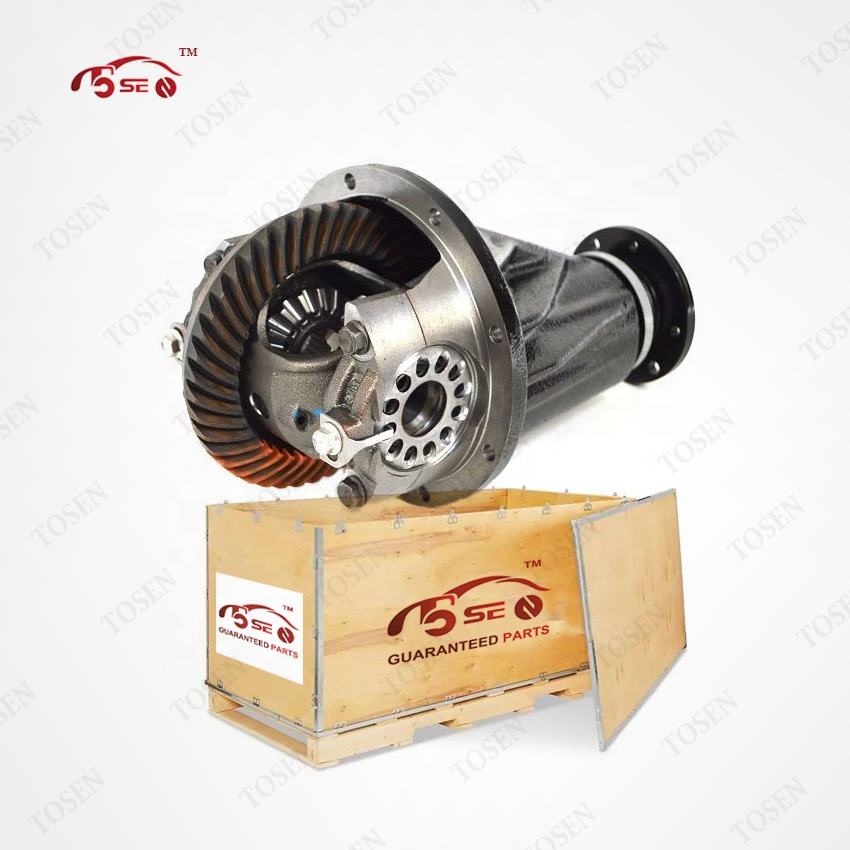
Run the comparison in both directions: your checklist against the old unit, and the old unit against the assembly being offered. The 9×41 Hiace assembly page lists the same comparison points — splines, flange, housing connections — because those are the fields a supplier matches before confirming an order. A supplier that does not ask for them is guessing.
Complete Assembly or Gear Set for Your Hiace
Two routes lead to a rebuilt rear axle. A complete assembly arrives as one unit — carrier, gears and bearings installed — and bolts in. A crown wheel and pinion set is the matched gear pair alone, and it goes into your existing carrier during a full setup. The right route depends on who does the work and what they can measure, not on the parts catalogue.
| Decision factor | Complete 9×41 assembly | Crown wheel and pinion set |
|---|---|---|
| What arrives | Fully assembled final-drive unit, inspected before shipping | Matched gear pair; carrier, bearings and shims are your side of the job |
| Skills needed | Bolt-in installation a general workshop can perform | Backlash and contact-pattern setup — specialist work |
| Equipment | Standard workshop tools | Setup tools and dial indicators, plus experience reading tooth contact patterns |
| Vehicle downtime | Shortest — swap the unit and return the van to service | Longer — the axle needs a full setup after the gears go in |
| Best suited to | Fleets and general repair shops | Differential rebuilders and specialist workshops |
The setup requirement is what separates the routes. Backlash — the small clearance between meshing teeth — must sit in the right range: too tight and the set runs hot, too loose and it knocks. Getting it right, and reading the contact pattern that proves it, is skilled work with instruments. Workshops without that capability should order the complete assembly; specialists with it can make a gear set the economical route. Our differential ratios guide covers the complete-unit-versus-parts question in general terms, and the differentials category lists assemblies across other Toyota combinations.
Build the Enquiry That Gets a Confirmed Fitment
A complete enquiry turns identification into a confirmed order on the first quote. Every item below exists because a supplier needs it to match a specific unit to a specific van — and each one is something this guide has already shown you how to capture.
- Vehicle identification and year — the context recorded with the order
- The axle code — the primary identifier matched against the unit supplied
- Crown wheel and pinion tooth counts — confirms the gear combination your axle actually carries
- Axle-shaft spline details — the first interface the assembly must match
- Flange and housing dimensions — the remaining interface checks
- Photos of the axle plate and the removed unit — the evidence the supplier verifies against
- Any part number cast or tagged on the old unit — supporting evidence, not proof on its own
- Quantity and destination port — what turns a fitment confirmation into a quotation
Send part numbers as supporting evidence, but do not let them carry the decision alone: numbers can repeat across different ratios, and after an axle swap the number on the unit describes that unit, not the van's factory record. The counts and the photos are what get verified. Then ask what comes back. Before the order is confirmed, the supplier checks the match on the actual unit being shipped: the pinion and crown-wheel teeth are counted, the gear mesh is checked, and the splines and input flange are examined. Photographs of the real assembly — its tooth counts and its stamped markings — can come with the quotation, so the record ties the purchase to the physical part. Send the packet to TOSEN for the 9×41 Hiace rear differential assembly and the fitment confirmation happens before money and freight move, not after.
Vans whose axle code points to a different combination get the same treatment: send the same evidence through the differential assemblies category and the verification runs the same way before anything ships.
What a Wrong Order Costs — and Which Check Prevents It
| Failure mode | What it costs | Check that prevents it |
|---|---|---|
| Wrong ratio discovered after installation | Return freight plus a fresh shipping cycle — and the van stays down the whole time | Tooth counts and the 41 ÷ 9 division |
| Right ratio, wrong splines or flange | Installation stops; a second unit and two more freight legs | The interface checklist before ordering |
| Front/rear mismatch on a 4WD Hiace | Drivetrain binding when four-wheel drive engages | Both axle codes compared with each other |
| Order placed on a stated ratio with no evidence | A dispute with no record of what was asked or shipped | Photos of the axle plate and old unit with the enquiry |
Standard lead time on an order like this runs 15–25 business days depending on destination, so every correction cycle costs weeks, not days. Every check in that table takes minutes and happens before money moves. That asymmetry is the entire argument for verifying first — the evidence packet is the cheapest component in the whole job.
Frequently Asked Questions
Does every Toyota Hiace take the same rear differential?
No. The axle code and the gear combination decide, and Hiace axles are not one-size-per-model. A 9×41 set is one of the combinations fitted to these vans, so a van with a different code takes a different unit. Never assume from the year badge or body style — read the axle.
Is the VIN useless when ordering a differential?
No, but it has a specific job. The VIN identifies the vehicle and gives the supplier order context, and a dealer can decode the factory build sheet from it. What it does not do is state the ratio installed in the axle today, so it cannot close the fitment question on its own.
My Hiace is 4WD — does that change what I check?
Yes. The front and rear axles must run the same ratio, or the drivetrain binds when four-wheel drive engages. Record both axle codes and both ratios, and match the replacement to the axle it is going into.
Should I buy a used or a new differential assembly?
A new assembly removes the unknowns of a used unit's history — bearing wear, prior setup, hidden damage. TOSEN supplies the 9×41 Hiace assembly as a brand-new unit inspected before shipping. If you do source used, apply the same verification: axle code, tooth counts, interfaces, photos.
Can my workshop install a crown wheel and pinion set ourselves?
Only if you can set backlash and read a tooth contact pattern with instruments, because the set installs into your carrier with a full setup. A general workshop without that capability should order the complete assembly, which arrives built and inspected.
The axle code and my tooth counts disagree — which one wins?
The teeth on the installed unit. A disagreement usually means the axle was swapped at some point, so the code no longer describes what is under the van. Photograph both pieces of evidence and let the supplier verify the match before shipping.
Can I start the order before the old unit is out of the van?
Yes. An axle-plate photo and the axle code are enough to start the enquiry and get the quotation moving. Confirm the tooth counts and interface details before the order ships, so the verification happens on evidence rather than assumptions.
Does it matter whether my Hiace has an open or limited-slip differential?
It matters in two places. The single-wheel rotation check only works on an open differential, so a limited-slip or locking unit needs the teeth counted instead. And the replacement should match the original traction type, so note which one the old unit carries when you send the enquiry.
Order on the Evidence, Not the Model Name
The correct differential for a Hiace is the one whose evidence matches the van: the axle code, the tooth counts and their ratio — 9×41 and 4.556 in the worked example here — and the splines, flange and housing the unit must bolt to. Every one of those is captured in photographs and counts that take minutes. A model name starts a conversation; the evidence closes an order, whatever combination the axle turns out to carry.
Send your Hiace differential evidence for a fitment-confirmed quotation: vehicle identification, axle code, crown wheel and pinion tooth counts, spline details, flange and housing dimensions, photos of the axle plate and old unit, plus quantity and destination port. The 9×41 rear differential assembly is the matched product; other combinations route through the same verification.